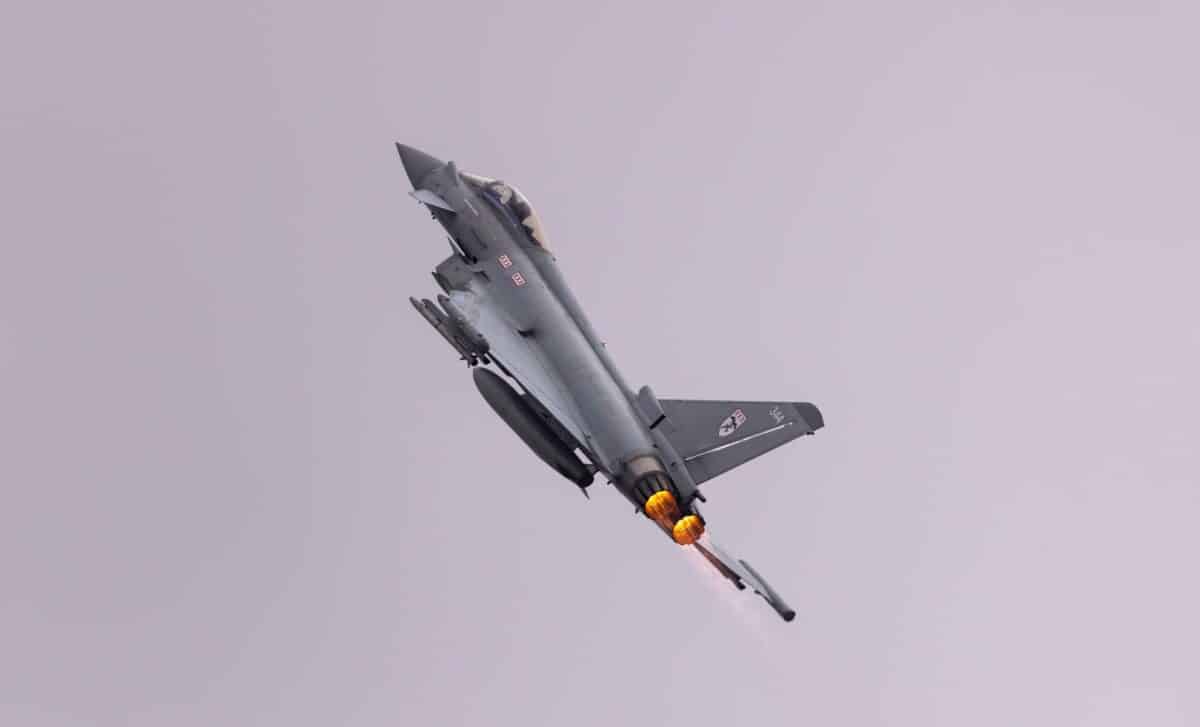
The United Kingdom has deployed a new low-cost anti-drone missile system on Royal Air Force Typhoon fighter jets operating in the Middle East. The move is intended to strengthen protection for British personnel, regional allies, and military assets facing growing drone threats across the region.
According to the UK Ministry of Defence, the Advanced Precision Kill Weapon System (APKWS) was tested and deployed within less than two months through cooperation with BAE Systems and QinetiQ. British officials say the system allows RAF pilots to intercept drones at a significantly lower cost than existing air-to-air missiles.
The deployment comes as drone warfare continues to shape military operations in the Middle East. Iranian-made Shahed drones and similar systems have been increasingly used in regional conflicts, prompting governments to seek more affordable interception methods. RAF aircraft have already logged more than 2,500 flying hours on defensive operations in the region since the conflict escalated.
RAF Typhoons Receive New Precision-Guided Missile System
The APKWS converts unguided rockets into precision-guided weapons through a laser-targeting system. According to the Ministry of Defence, the missiles are now operational on RAF Typhoon jets flown by 9 Squadron during missions aimed at defending British interests and regional partners.
The British government stated that RAF pilots from 41 Test and Evaluation Squadron successfully conducted air-to-air firing trials in April following an earlier strike test against a ground target in March. Officials described the process from testing to operational deployment as unusually rapid.
Luke Pollard, the UK Minister for Defence Readiness and Industry, said the new system would help the RAF “shoot down many more drones at a much lower cost.” He also described the Typhoon fleet as the “backbone” of both UK and NATO air defense operations.
According to BBC reporting, interceptor missiles previously used against drones in the region could cost around £200,000 each. By comparison, APKWS rockets used by other countries have been estimated by defense analysts to cost roughly $30,000 per unit. The BBC also noted that this places the system closer in cost to Iranian Shahed drones, which are estimated at between $20,000 and $50,000. The APKWS is already used by the United States military, and Qatar has reportedly sought to acquire 10,000 units from the US in recent months to improve its own air defenses.
Drone Threats Continue to Reshape Regional Air Defense Strategies
Drone attacks have increasingly targeted military facilities and allied infrastructure across the Middle East. According to BBC News, a drone struck RAF Akrotiri in Cyprus in March, causing what authorities described as minimal damage. Two additional drones were intercepted shortly afterward.
The Ministry of Defence said UK aircraft remain on high readiness across the region alongside ground-based and helicopter-based defense systems. These include the Sky Sabre system in Saudi Arabia, Lightweight Multirole Missiles in Bahrain, and the Rapid Sentry and ORCUS systems in Kuwait.
British officials linked the deployment to the broader rise in drone warfare. The Ministry of Defence stated that developing lower-cost interception systems offers a more sustainable response to the growing use of drones in modern conflicts.
BAE Systems executive Simon Barnes said the capability demonstrates the Typhoon’s operational flexibility and continued role in combat air operations across Europe and the Middle East. QinetiQ chief executive Steve Wadey said company teams had supported the urgent delivery of systems intended to keep UK forces and allies “warfighting ready.”
The announcement follows other recent UK defense investments. According to the Ministry of Defence, Britain recently signed a contract to acquire Skyhammer interceptor missiles designed to counter Shahed-style drones and committed more than £650 million earlier this year to upgrade the RAF Typhoon fleet through the 2040s.