The figures point to a housing market in which national price growth has weakened while substantial regional differences remain. According to the Office for National Statistics, part of the slowdown reflects comparisons with May and June 2025, when average prices rebounded after a sharp fall in April following stamp duty changes in England and Northern Ireland.
Regional Gaps Remain Wide as London Prices Continue to Fall
Average house prices in England increased by 1.8% over the year to June, reaching £293,000. Wales recorded the same annual growth rate, with the average price rising to £213,000, while Scotland posted a 2.3% increase to £195,000.
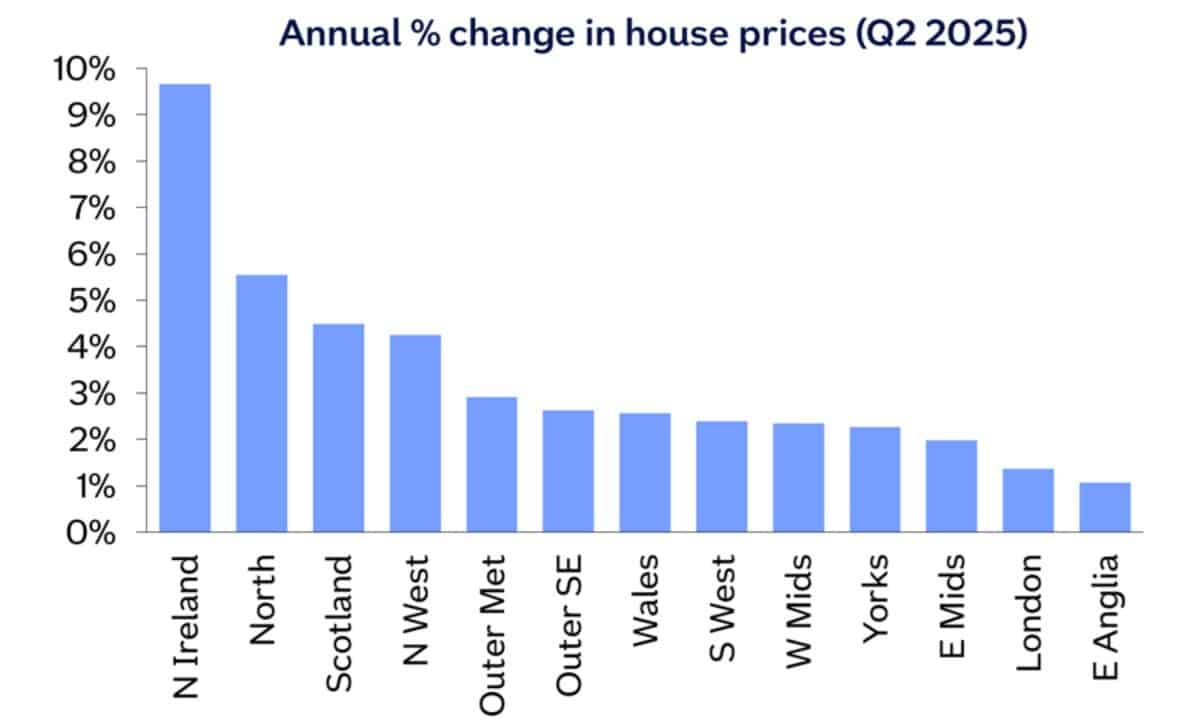
Northern Ireland remained markedly stronger than the other UK nations. According to the ONS, the average property price there reached £202,000 in the second quarter of 2026, 9.2% higher than a year earlier. This was Northern Ireland’s highest annual house price inflation rate since the fourth quarter of 2022.
Within England, the North West recorded the strongest annual house price growth, at 4.7% in the 12 months to June. London remained the weakest-performing region, with average prices falling by 2.5% over the same period. The decline was smaller than the 3.1% fall recorded in May. June was the tenth month in succession in which London recorded annual price falls. The ONS said the weakness was mainly driven by falling prices in Inner London.
The monthly movement was also limited nationally. Mortgage Strategy reported that average UK prices increased by 0.1% between May and June 2026, compared with a 1.0% monthly rise over the equivalent period a year earlier. That comparison contributed to the lower annual growth rate.
Inflation and Mortgage Conditions Add Pressure to the Market
The housing figures were released alongside new inflation data. According to the ONS, Consumer Prices Index inflation rose to 2.9% in July, up from 2.6% in June, which had been a 15-month low.
David Hollingworth, associate director at L&C Mortgages, said the rise was “largely in line with market expectations” and noted that financial markets were already factoring in the possibility of higher interest rates to address inflation. He also said mortgage rates could continue to move in both directions because of the volatile backdrop.
Quilter financial planner Ian Futcher said some of the slowdown in annual house price growth was mechanical because of the stamp duty changes in April 2025. He also said mortgage lenders had since been competing more strongly for business and that mortgage pricing had improved for many borrowers.
Atom chief commercial officer Chris Storey described the market as cautious, saying prospective buyers had become more wary as global events affected mortgage rates and monthly household costs. He also pointed to reports of weaker asking prices in August, a 12-year high in the number of homes available and longer selling times.
Private rents continued to rise alongside the softer housing market. The ONS said the average monthly private rent across the UK reached £1,393 in July, around £50, or 3.7%, higher than a year earlier.