The first snowfall of the season can arrive within weeks in some parts of the United States, while other regions may wait until winter is well underway. A new guide from Farmers’ Almanac shows how snow timing varies from September mountain storms to later-season events across the South.
A U.S. Snow Timeline Varies From Region To Region
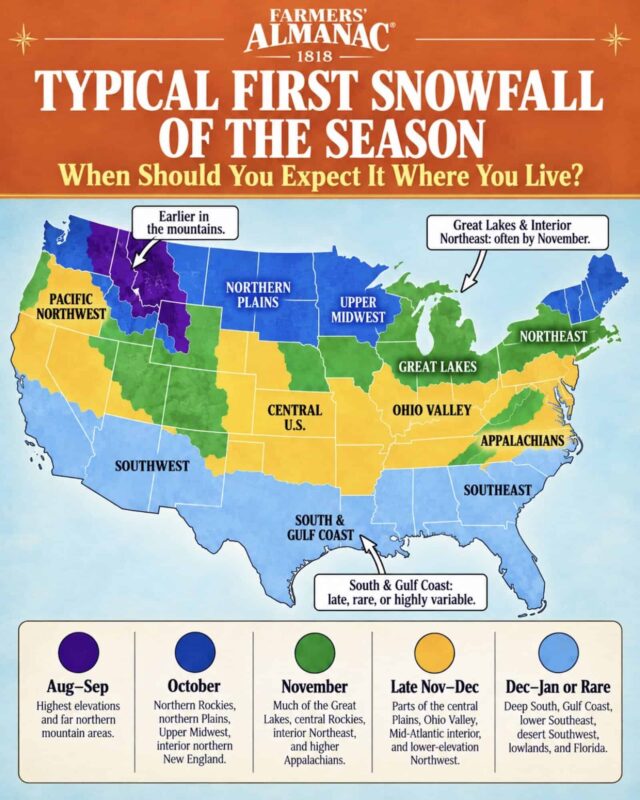
The first snow does not arrive on the same schedule across the country. High elevations in the northern Rockies can see snow as early as August or September, while much of the Northern Plains, Upper Midwest, and northern mountain areas usually experience their first measurable snowfall during October or early November.
According to Farmers’ Almanac, the typical first snowfall pattern across the Lower 48 follows five broad periods: September snow in the highest elevations, October snow across northern areas, November snow around the Great Lakes and interior Northeast, late November through December snow across central regions, and December or later events in much of the southern United States.
The timing remains a climate guide rather than a prediction for one specific storm. Elevation, latitude, nearby water and yearly weather patterns can shift snowfall dates by several weeks.
Why Some Areas See Snow Earlier Than Others
Elevation plays a major role in early-season snowfall. Mountain peaks can reach freezing temperatures while nearby valleys remain warm enough for rain.
Northern locations also cool faster as daylight decreases in autumn. Areas near the Great Lakes can experience an additional snowfall boost when cold air moves over warmer lake water, creating lake-effect snow bands.
Coastal areas often follow a different schedule. Large bodies of water moderate temperatures, which can delay the arrival of accumulating snow compared with inland locations at similar latitudes.
November Often Marks A Major Shift Toward Winter
For many northern communities, November is the month when the chance of measurable snow rises sharply. The Great Lakes, Upper Midwest, interior Northeast and higher Appalachian areas commonly see their first accumulating snow during this period.
Cities can also experience large differences from year to year. Farmers’ Almanac notes that averages provide a general picture, but individual seasons can bring much earlier or later snowfall.
Denver, for example, has an average first measurable snowfall date around October 18, yet the city has recorded measurable snow as early as September 3.
The South Faces A Less Predictable Snow Season
Snow becomes far less consistent closer to the Gulf Coast. Parts of Louisiana, Mississippi, southern Alabama, coastal South Carolina, Florida, and southern Texas may go an entire winter without measurable snowfall.
When snow does reach these areas, it usually depends on a rare combination of cold air and available moisture rather than a predictable annual date.
The First Snowfall Depends On What You Mean By Snow
The first flakes of a season are not always the same as the first measurable snowfall. Meteorologists commonly separate three milestones.
The first flakes are simply snow observed falling, even if they melt immediately. Measurable snowfall generally requires at least 0.1 inch of accumulation, while a significant snowfall usually means an inch or more has covered the ground.
Those events can happen weeks apart. A location may see its first brief snow shower in autumn before recording a true accumulating snowfall later in the season.
Snow Can Arrive Before Winter Officially Begins
Winter does not need to arrive on the calendar before snow appears. Cold air outbreaks can bring snow well before the December solstice, especially across northern states and mountain regions.
The 2026 astronomical winter season begins on December 21, but many locations normally record their first snow long before that date.
The Farmers’ Almanac map identifies typical first snowfall periods rather than a guaranteed schedule. It shows that the highest northern mountains can receive snow during September, while many southern locations may wait until December or January.