The divide between state and federal minimum wages continues to grow across the United States as new wage increases take effect in several parts of the country. While many states have adopted higher pay floors, the federal minimum wage has remained unchanged since 2009.
The latest round of increases, effective July 1, reflects continued efforts by state and local governments to address inflation and the rising cost of living. According to the Economic Policy Institute (EPI), these changes will increase earnings for hundreds of thousands of workers, while lawmakers in Congress continue debating proposals to raise the national minimum wage. Minimum wage policies now vary widely across the country, creating significant differences in what workers can legally earn depending on where they live.
State Wage Floors Continue to Move Away From the Federal Standard
The federal minimum wage remains at $7.25 per hour, where it has stood since the final phase of the Fair Minimum Wage Act of 2007 took effect in 2009. According to Newsweek, 20 states still use that federal rate as their wage floor, either because they have no state minimum wage or because their state rate falls below the federal standard.
Meanwhile, 30 states and the District of Columbia require employers to pay more than the federal minimum. Washington has the highest statewide minimum wage at $17.13 per hour, while the District of Columbia has a minimum wage of $18.40 per hour. Other states with comparatively high minimum wages include Connecticut at $16.94, California at $16.90, and Rhode Island at $16.
According to the Economic Policy Institute, the purchasing power of the federal minimum wage has steadily declined. The organization reported that a worker earning the federal minimum wage in 2022 received 27.4% less in inflation-adjusted terms than a worker earning the same wage in July 2009. Compared with its historical peak in 1968, the federal minimum wage had lost 40.2% of its purchasing power by 2022.
These differences have contributed to an increasingly uneven wage landscape across the country as more states establish higher minimum pay standards through legislation, ballot measures, or automatic inflation adjustments.
July Increases Affect More Than 361,000 Workers as Congress Weighs Federal Proposal
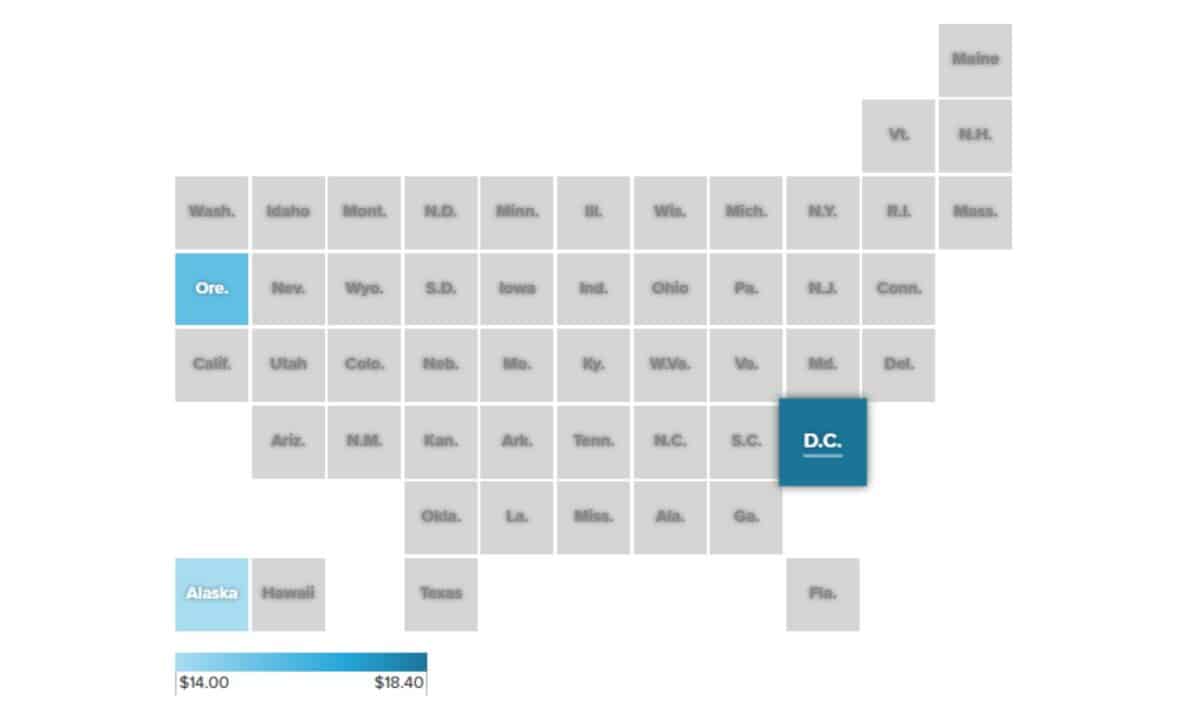
On July 1, minimum wage increases took effect in Alaska, Oregon, and the District of Columbia. According to the Economic Policy Institute, the three changes will raise wages for more than 361,000 workers and increase total annual earnings by more than $221 million.
The EPI reported that Alaska’s increase to $14.00 per hour resulted from a ballot measure, while Oregon and the District of Columbia implemented inflation-based adjustments. The organization estimated that average annual wage gains for full-time workers range from $573 in Oregon to $811 in Alaska.
Fourteen cities and counties also introduced higher minimum wages this summer. Most are located in California, including Los Angeles, San Francisco, Berkeley, Emeryville, and Pasadena. Chicago, Cook County in Illinois, and Montgomery County, Maryland, also raised their local wage floors through inflation adjustments or local ordinances.
At the federal level, lawmakers are considering legislation known as the Living Wage for All Act. According to Newsweek, the proposal introduced by Senator Chris Murphy and Representative Delia Ramirez would gradually increase the federal minimum wage to $25 per hour.
The proposal would begin by increasing the federal minimum wage to $12 per hour, followed by a phased increase to $25 per hour. Large employers would be required to meet that threshold during the 2031–2032 period, while smaller businesses would have until the 2038–2039 period to comply.