
Millions of households could face higher Council Tax bills next year, but some homeowners may be paying more than necessary because their property is in the wrong band. Challenging an incorrect band can cut annual bills and, in some cases, lead to a backdated refund worth thousands of pounds.
Council Tax Bills Could Rise Again Next Year
Council Tax is collected by local authorities to fund services such as rubbish collection, road maintenance, policing and social care. Bills normally rise on April 1, with most councils subject to a 5% limit unless they hold a local referendum.
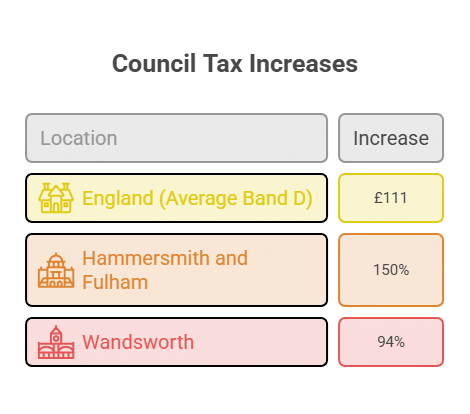
The average Band D Council Tax bill in England rose to £2,392 this year, an increase of £111. Some households could face much larger increases next year. In Hammersmith and Fulham, a 150% increase has been discussed as one possible scenario. Wandsworth has also announced plans for a rise of 94%.
The final amount households pay will depend on decisions made by their local authority.
Thousands Of Homes Could Be In The Wrong Band
Council Tax bands in England range from A to H. They are based on the estimated value of properties on April 1, 1991, rather than their current market value. Some properties may have been placed in the wrong band, leaving homeowners paying more than they should.
Checking nearby properties can provide an initial indication. If similar homes on the same street are in lower bands, it may be worth investigating further. Differences between properties do not automatically mean that a Council Tax band is incorrect, so homeowners need to compare genuinely similar properties.
How To Check Your Council Tax Band
Homeowners can find their current band on their latest Council Tax bill. The Government also has a free online checker at: Check your Council Tax band
The service can also show the bands assigned to neighbouring properties. When comparing homes, look for properties that are similar in terms of size, age, type and design. Historical property sale prices can also be used as supporting evidence when examining whether a band appears incorrect.
How To Challenge Your Council Tax Band
If you believe your property has been placed in the wrong band, you can submit a challenge through the Valuation Office Agency. The process is free. Homeowners should first gather evidence showing why their property may have been incorrectly assessed. Comparisons with similar nearby properties can be useful.
People who have been paying Council Tax at their property for less than six months generally have a legal right to make a formal challenge. The same can apply where a band was changed within the previous six months or where certain changes have affected the property or its surrounding area.
Those who have been paying Council Tax for longer can still ask for their band to be reviewed, though stronger evidence may be needed. The challenge can be started through the Government’s official website: Challenge your Council Tax band
A Successful Challenge Could Lead To A Refund
If the Valuation Office agrees that a property has been placed in the wrong band, the band can be changed. A homeowner may then receive a refund for previous Council Tax overpayments, depending on the circumstances.
Previous cases show that refunds can reach thousands of pounds. One homeowner, Martin Rayner, had his property moved from Band E to Band D and said the change saved him around £9,300.
Another homeowner received a reported £7,603 refund after successfully challenging their Council Tax position. These cases do not mean every successful challenge will result in a large refund. The amount depends on the property, its previous band and how long the overpayment lasted.
There Is A Risk Of A Higher Bill
Homeowners should check the evidence carefully before submitting a challenge. If the Valuation Office determines that a property has actually been placed in a band that is too low, the Council Tax band could be increased.
That means a challenge can result in a higher bill rather than a lower one. Anyone considering a challenge should therefore compare their property with genuinely similar homes and gather supporting evidence before submitting a request.
Council Tax Band Could Also Affect Energy Support
Checking your Council Tax band could have another financial consequence for some households. The Government has announced a £100 energy payment for eligible households in England living in Council Tax bands A to D.
The payments are expected to be made from January 2027. For households whose band is incorrect, resolving the issue could therefore affect their eligibility for certain forms of support as well as their Council Tax bill.
Homeowners facing higher bills can check their Council Tax band through the Government’s online service before deciding whether they have grounds to challenge it.