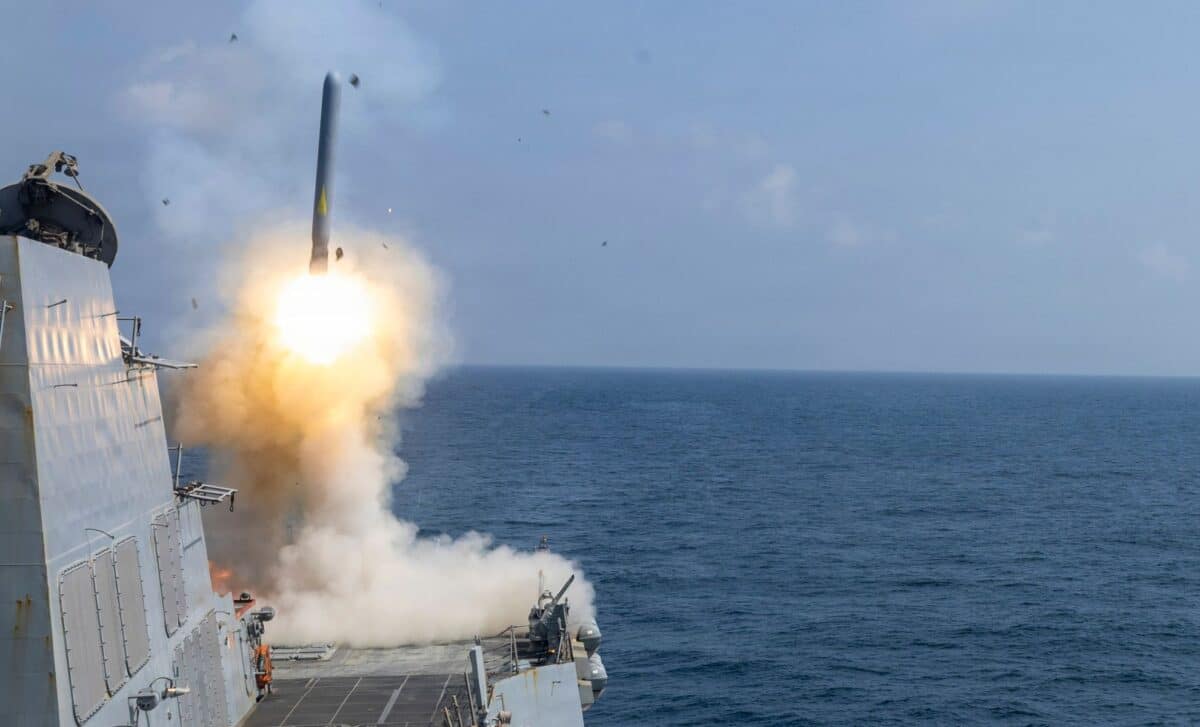
The Pentagon’s fiscal year 2027 budget request includes a dramatic expansion of naval missile procurement, with the US Navy seeking funds for hundreds of Tomahawk cruise missiles and SM-6 interceptors. The proposal follows sustained combat operations in the Middle East that have consumed munitions at an unprecedented rate.
According to Pentagon budget documents, the Navy is requesting 785 Tomahawk Land Attack Missiles at a cost of approximately $3 billion, alongside 540 SM-6 missiles for roughly $4.33 billion. The combined $7.3 billion outlay represents one of the most significant jumps in naval munitions procurement in recent years.
A Dramatic Departure from Previous Spending
The scale of the request becomes clearer in comparison to the previous year’s figures. Congress funded just 55 Tomahawk missiles for $258 million in fiscal year 2026, the new request represents an increase of more than 1,200 per cent. SM-6 procurement is also set to rise substantially, up from 166 missiles costing $1.41 billion to 540 at $4.33 billion, a 225 per cent increase.
The Navy has also requested 494 AIM-120 Advanced Medium-Range Air-to-Air Missiles at $804 million, a 370 per cent increase over 2026 levels, and 141 MK-48 heavyweight torpedoes for $571 million. Overall weapons procurement stands at more than $22 billion in the request, compared with roughly $10 billion in the prior year.
Funding for the Tomahawks and SM-6s is split between the standard budget and a federal reconciliation bill, a structure that would allow procurement to be spread across several years. According to Todd Harrison, a senior fellow at the American Enterprise Institute, the approach is designed to give manufacturers greater production certainty rather than to accelerate near-term deliveries. “They’re frontloading the money, and then we’ll spend it out more slowly than is typical,” Harrison said, noting that SM-6 production timelines can exceed 36 months and Tomahawk manufacturing can require more than two years of lead time.
Combat Consumption Drives Urgency
The impetus behind the request is the rate at which these weapons have been expended during Operation Epic Fury. As of late March, the US Navy had fired approximately 850 Tomahawk missiles since the operation began on 28 February, the highest usage of the weapon in any single military campaign, surpassing the 802 fired during Operation Iraqi Freedom, according to a report from the Centre for Strategic and International Studies.
Mark Cancian, one of the CSIS report’s authors, told Military Times that replacing the 850 expended Tomahawks alone would take two to three years. The heavy use has also affected third-party agreements; Japan’s order for roughly 400 Tomahawk missiles, originally due for completion by March 2028, is reportedly facing delays as a result.
Harrison acknowledged that the procurement targets are necessary but cautioned over their feasibility. The United States “absolutely” needs to acquire these quantities, he said, but added there is “not a chance” the industrial base can currently support the plan at the pace implied. RTX, which manufactures the Tomahawk, produced 100 new missiles in 2025 and signed an agreement with the Defence Department in February 2026 to increase annual output to as many as 1,000 over a potential seven-year period.