The U.S. housing market is experiencing its sharpest slowdown in nearly nine years, with median asking prices declining across much of the country. After years of rapid growth during the pandemic, buyers are now retreating, and sellers are adjusting expectations, according to recent data from Realtor.com.
This shift marks a turning point in the housing landscape, where high mortgage rates, affordability pressures, and broader economic uncertainty are influencing buyer behavior. The trend is being felt nationwide, with previously booming markets showing some of the steepest declines in asking prices.
Broad-Based Price Declines Signal Market Adjustment
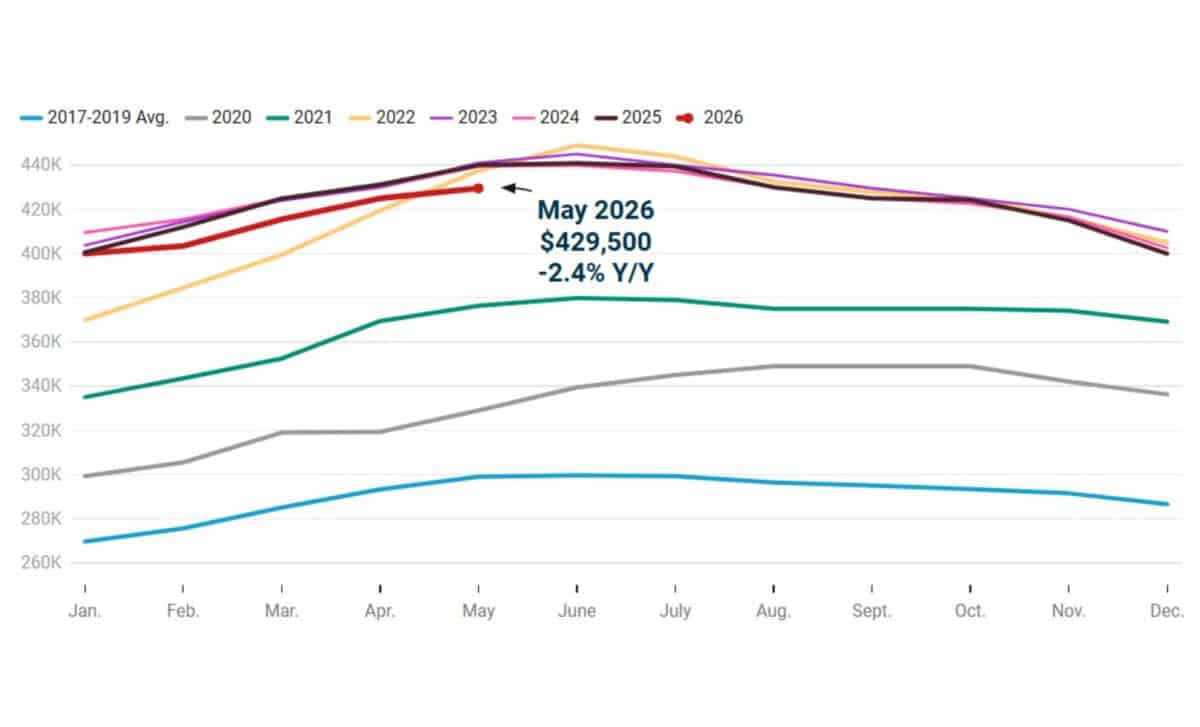
According to Realtor.com, the national median listing price has dropped for seven consecutive months. In May, the median asking price fell 2.4 percent year-over-year to $429,500, representing the steepest annual decline since at least 2017. Price weakness is widespread, with the median price per square foot down 2.5 percent year-over-year and declines reported in 35 of the 50 largest U.S. metropolitan areas.
Several cities that saw sharp corrections were once among the pandemic-era growth hotspots. Memphis, Tennessee, recorded the largest drop at 13 percent, followed by Buffalo, New York at 11.6 percent, and Austin, Texas at 9.5 percent. Los Angeles, California, also experienced a notable decline of 7.9 percent in its median asking price. Realtor.com senior economist Jake Krimmel observed that some markets, like Memphis, are experiencing stagnation, where falling prices do not yet appear to be stimulating buyer activity.
In Austin, the slowdown is driven by rising inventory and declining demand, partially linked to the end of the pandemic and the return-to-office policies, according to the data. Meanwhile, in Los Angeles, real estate agent Victor Currie explained that buyers are reacting cautiously to factors including geopolitical tensions related to the Iran war, inflation, and higher interest rates. These influences contributed to the absence of the typical spring buying increase in the city.
Buyers and Sellers Adapting to New Market Realities
While asking prices have fallen sharply, the market does not appear to be headed for a crash this year. According to Hannah Jones, senior economist at Realtor.com, ongoing challenges include affordability constraints, existing homeowners’ reluctance to list properties, and the pace of new construction relative to long-term demand. These factors are expected to sustain a relatively sluggish housing market unless mortgage rates decline significantly.
The shift in pricing strategy is also notable. Sellers are increasingly setting realistic prices from the outset, rather than testing the market, reducing the share of listings with price reductions to 17.5 percent, down 1.6 points from last year, according to Realtor.com. Krimmel noted that this approach reflects a more measured seller mindset, where homes are priced to sell rather than to gauge market limits.
Data indicates that buyers are responding to these adjustments. The number of homes going under contract in May rose for the sixth straight month, climbing 4.3 percent from a year earlier. According to the report, many markets have been moving in a buyer-friendly direction for some time, with pricing now more closely aligned with what buyers can afford. This has led to more active engagement, even amid higher interest rates, suggesting a market adapting to current economic realities rather than one in crisis.