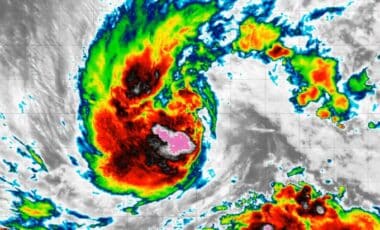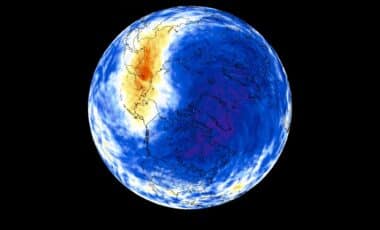
The storm arrived during an unusually quiet Atlantic season that has yet to produce a hurricane. Fay is expected to strengthen somewhat in the short term, but forecasters say changing atmospheric conditions should limit its development and eventually cause the system to weaken.
Fay Develops Southwest of the Azores
According to the National Hurricane Center, Tropical Storm Fay had maximum sustained winds of 45 mph at 5 a.m. EDT on September 20 and was moving north-northeast at about 5 mph. Its center was near latitude 33 degrees north and longitude 33 degrees west, roughly 450 miles southwest of the Azores.
The National Hurricane Center reported a minimum central pressure of 1004 millibars. Tropical-storm-force winds extended outward as far as 45 miles from the center. Forecasters expected Fay to continue on its general path for about another day before turning toward the southwest on Monday. No coastal watches or warnings had been issued.
The Azores are an autonomous region of Portugal located about 800 miles from mainland Portugal. Despite Fay’s position southwest of the island group, forecasters did not expect direct impacts on land.
The National Hurricane Center said conditions involving relatively moist air and the interaction of warmer and cooler environments could allow Fay to gain some strength during the next 12 to 24 hours. That opportunity is expected to be limited.
Increasing wind shear and dry air are expected to make further strengthening more difficult. Fay is likely to become a remnant low on Tuesday and dissipate by the end of the week, according to forecasts.
A Notably Quiet Atlantic Hurricane Season
Fay is the sixth named storm of the 2026 Atlantic season, following Arthur, Bertha, Cristobal, Dolly and Edouard. The next name on the list is Gonzalo.
The Atlantic hurricane season runs from June 1 through November 30. September 10 marks the statistical peak, with the greatest amount of tropical cyclone activity typically occurring between mid-August and mid-October.
This season has developed at an unusually slow pace. According to AccuWeather, as cited by the South Florida Sun Sentinel, the “F” storm typically forms by August 29. Fay did not form until September 20.
The same report said 2026 had already set a record for the longest start to an Atlantic hurricane season without a storm becoming a hurricane during the satellite era. AccuWeather also reported that if no Atlantic hurricane forms through September 21, the season would set a record for the latest arrival of its first hurricane.
Historical averages provide another measure of the slow activity. NOAA’s 1991-2020 average is 14 named storms, seven hurricanes and three major hurricanes during an Atlantic season.
The National Hurricane Center was also monitoring two tropical waves, one in the central Atlantic and another in the western Caribbean. At the time of the reports, neither had changed the immediate assessment surrounding Fay: the newly named storm remained over the open Atlantic, with no direct threat to land.