
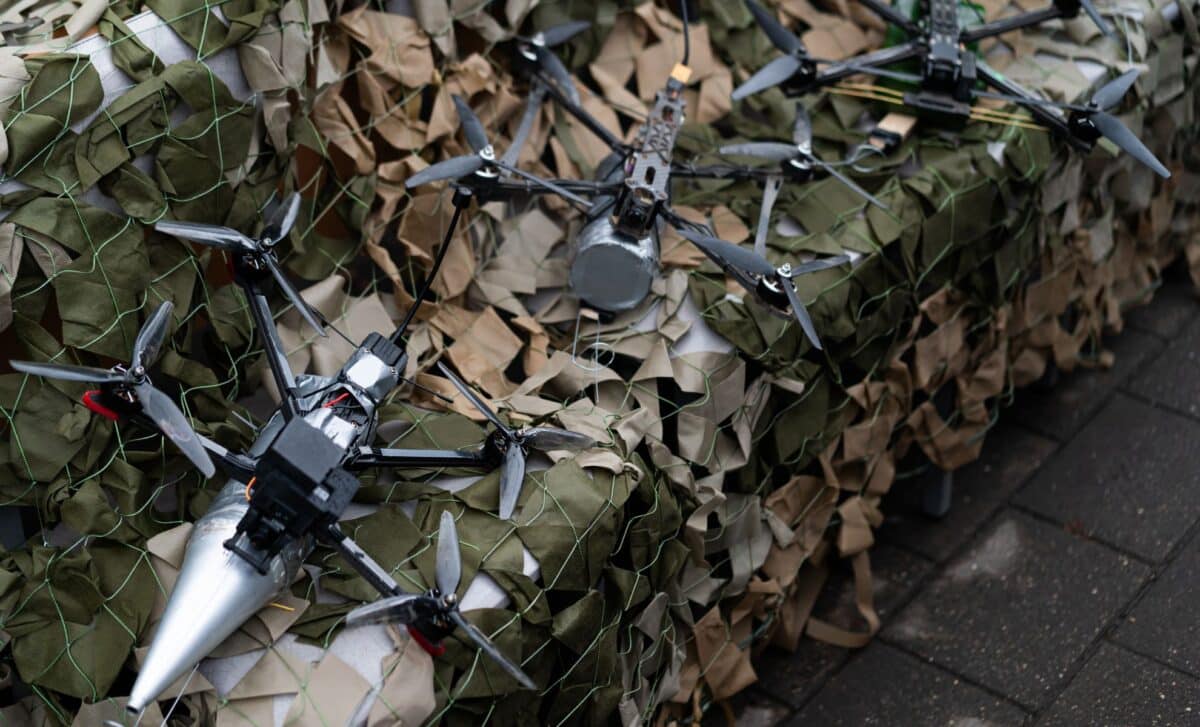
The United States is accelerating domestic drone production in response to lessons drawn from the war in Ukraine. A competitive federal program is now selecting manufacturers to supply hundreds of thousands of strike drones.
The Pentagon launched a $1.1 billion Drone Dominance Program in December 2025 to procure and deploy hundreds of thousands of low-cost, one-way attack drones. The initiative reflects a broader shift in military thinking prompted by Ukraine’s effective use of inexpensive unmanned systems against Russian forces, a development that has fundamentally altered how defence planners assess battlefield technology.
Central to the program’s design is a requirement for domestic manufacturing. The United States is seeking to produce these systems entirely within its own borders, reducing dependence on foreign suppliers that could potentially restrict or cut off access during periods of conflict or diplomatic tension.
A Competitive Selection Process Narrows the Field
The Pentagon structured its procurement through a series of field evaluations it refers to as “gauntlets,” in which military operators assess drones under combat-readiness conditions. An initial group of 25 vendors was invited to participate in competitive trials held in Georgia, with the field subsequently reduced to 12 finalists.
Those finalists are now positioned to receive a share of $150 million in initial federal funding, tied to the delivery of 30,000 low-cost attack drone units. According to the program’s timeline, three additional gauntlets will follow, with the supplier pool expected to be narrowed to five companies by early 2027.
The layered selection process reflects the Pentagon’s intent to identify manufacturers capable of sustained, scalable production rather than simply prototype development. Compliance with the National Defense Authorization Act is also a prerequisite, meaning all components must be sourced without reliance on Chinese suppliers.
Drone Demand Grows as Geopolitical Pressures Intensify
The Drone Dominance Program sits within a wider context of rising defence expenditure and evolving threat assessments. Unmanned aerial and surface systems are increasingly central to military planning, and domestic production capacity has become a strategic priority alongside raw technological capability.
One of the 12 finalists is Red Cat Holdings, whose subsidiary Teal Drones participated in the initial Georgia trials. The company had fast-tracked development of a product called the FANG F7, described as an ultra-low-cost FPV strike drone intended as an inexpensive alternative to conventional missiles.
According to the company, its updated supply chain is fully NDAA-compliant, containing no Chinese-sourced components, a qualification that aligns directly with the Pentagon’s domestic manufacturing requirements.
Red Cat reported quarterly revenue of $15.5 million, representing growth of 849% compared with the same period the previous year. Management has guided for between $150 million and $180 million in annual revenue for the current year. The company states its existing production infrastructure has the capacity to support up to $1 billion in revenue.
Whether Red Cat or its rivals ultimately secure the largest share of Pentagon contracts will depend on subsequent gauntlet performance. What is already clear, however, is that the Drone Dominance Programme marks a significant institutional commitment to unmanned systems, one that is reshaping how the United States approaches both procurement and the future of aerial warfare.