Aldi is pursuing its largest single-year U.S. expansion while simultaneously closing selected stores, a contrast that is leaving some communities without a familiar source of affordable groceries even as the discount chain pushes into new markets.
Aldi Is Growing Fast While Closing Selected Stores
According to The Street, the apparent contradiction at the center of Aldi’s 2026 strategy is largely a matter of geography: a retailer can expand rapidly nationwide while deciding that individual locations no longer fit its store network. According to The Street, Aldi operates more than 2,500 stores across 41 states and Washington, D.C., and the company plans to open more than 225 new locations in 2026. That would represent its largest single-year expansion to date and forms part of a five-year, $9 billion growth strategy.
Aldi expects its U.S. footprint to approach 2,800 stores by the end of 2026, followed by approximately 3,200 by the end of 2028. The scale of those ambitions makes the stores being closed a small fraction of the overall network, but percentages tell only part of the story. A supermarket that disappears from a neighborhood can matter far more to the people living within walking distance than hundreds of openings elsewhere in the country. Aldi U.S. CEO Atty McGrath framed the company’s plans around reaching more consumers:
“One in three U.S. households shopped at ALDI this past year, and in 2026, we’re focused on making it even easier for customers to shop our aisles first,” McGrath said in a press release. She added: “That means bringing ALDI to even more neighborhoods, upgrading our website and planning additional distribution centers to keep our shelves stocked with the products our shoppers love.”
The result is a rapidly expanding national chain whose local footprint is still being recalibrated market by market.
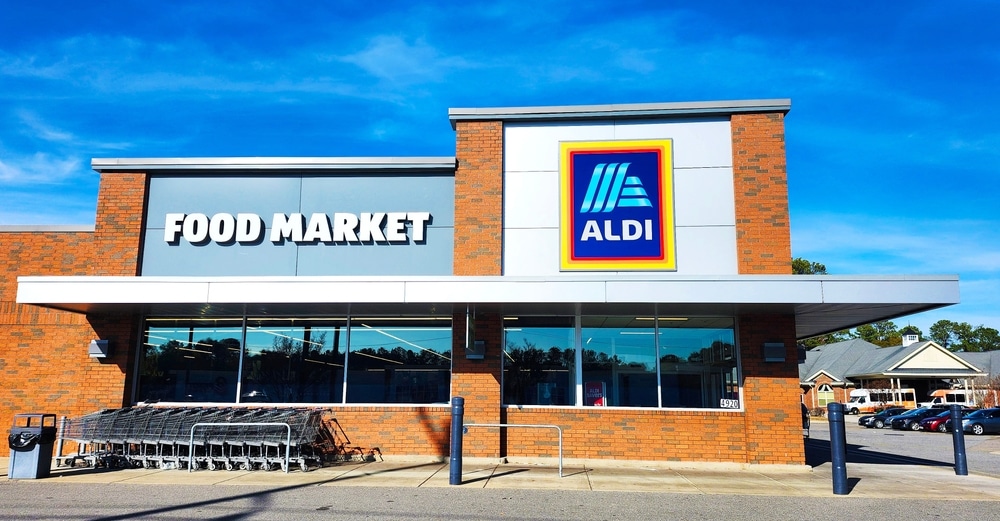
Credit: Shutterstock
These Aldi Locations Have Closed in 2026
The closures reported for 2026 are spread across Minnesota, Illinois, Texas and Wisconsin, rather than concentrated in a single region. The locations identified as closed are 1451 Riverwood Drive in Burnsville, Minnesota; 1202 W. Dundee Road in Buffalo Grove, Illinois; 9779 Forest Lane #200c in Dallas, Texas; 7440 McCart Ave. in Fort Worth, Texas; 5301 N. Hopkins Street in Milwaukee, Wisconsin; and 1712 S. 108th Street in West Allis, Wisconsin. Aldi also closed 22 locations in 2025, showing that store exits are occurring alongside the company’s broader expansion. For a retailer operating thousands of locations, opening and closing stores is a normal part of managing a national portfolio. Chains routinely examine sales, leases, operating costs, population patterns, competition and the performance of nearby stores when deciding where capital should be deployed.
Research published in the Journal of Retailing has examined how chain retailers use openings and closures to adjust distribution networks and improve performance. What looks inconsistent from the perspective of an individual shopper can therefore make sense at the scale of a national network. Aldi can withdraw from one neighborhood while investing in another city where executives see stronger demand or a better long-term operating environment. Yet the economic logic behind a closure does not erase its practical consequences, particularly when the departing supermarket served people who do not have easy access to a car.
When a Discount Grocery Store Disappears, the Impact Can Be Immediate
The consequences become clearer at street level, where grocery access is measured in blocks, bus routes and travel time rather than national store counts. Theron Hawk, discussing the loss of a Chicago-area Aldi, described how closely the location had been connected to his decision to live without a vehicle.
“Of course, Aldi was the asset,” Hawk said. “I got rid of my car, that’s why it was so easy for me to make the change.” After the Aldi closed, the presence of another store across the street did not necessarily provide an equivalent replacement. “We have a store directly across the street from Aldi,” Hawk said. “It has a sign that says Madison Supermarket, but they’re not a supermarket. They’re like a candy store, a cigarette store, can’t buy a loaf of bread there, can’t buy a gallon of milk there.”
His experience illustrates an important distinction in discussions about food access: having a retail business nearby is not the same as having a full grocery store offering staple foods, produce and other everyday necessities. For households with cars, a closure might mean adding several minutes to a weekly trip. For people who walk, cycle or rely on public transportation, the same closure can reshape how frequently they shop, how much they can carry and which foods are realistically available to them. That difference explains why supermarket closures often generate community concern that goes beyond the reaction to the loss of a conventional retail store.
Aldi’s Closures Are Part of a Wider Grocery Shake-Up
Aldi is far from the only grocery operator changing its physical footprint in 2026. Across the industry, several major chains have been eliminating stores or consolidating their networks even as others continue opening locations. Kroger has planned roughly 60 closures across banners including Fred Meyer, Fry’s, Harris Teeter, King Soopers, Mariano’s, Pick ’n Save and QFC, with 33 reported closed so far. Albertsons has reportedly closed more than a dozen locations in 2026 after roughly 30 closures in 2025.
Amazon announced the closure of all 72 Amazon Fresh and Amazon Go stores in January, marking a major retreat from those physical grocery formats. Grocery Outlet has also been associated with 36 closures after its CEO acknowledged overexpansion following a reported $218 million fourth-quarter net loss. In Chicago, seven Save A Lot stores on the South and West sides closed on July 25, while Winn-
Dixie and Harveys have also reduced their footprints as their operations shift toward Florida. Oklahoma-based Homeland has been linked to 17 closures, while Brookshire closed four stores in Louisiana and Arkansas in July. These decisions come from companies with different business models and financial circumstances, so they should not be treated as evidence of one uniform industry problem. Taken together, though, they show how aggressively grocery companies are reassessing where physical stores still fit their strategies.