
A full-time minimum-wage worker cannot afford a typical one-bedroom apartment under the 30% affordability rule in any of the 50 largest U.S. metropolitan areas studied by Best Interest Financial. In several cities, the problem is more immediate: monthly rent alone exceeds the worker’s entire gross paycheck.
The federal minimum wage has remained at $7.25 an hour since 2009. According to Best Interest Financial, workers earning that rate bring in about $1,160 a month before taxes, while the amount they could reasonably devote to rent under the 30% rule is just $348. The study compared local minimum wages with 2026 fair market rent data from the U.S. Department of Housing and Urban Development.
Seven Cities Show How Far Rent Has Moved beyond Minimum-Wage Income
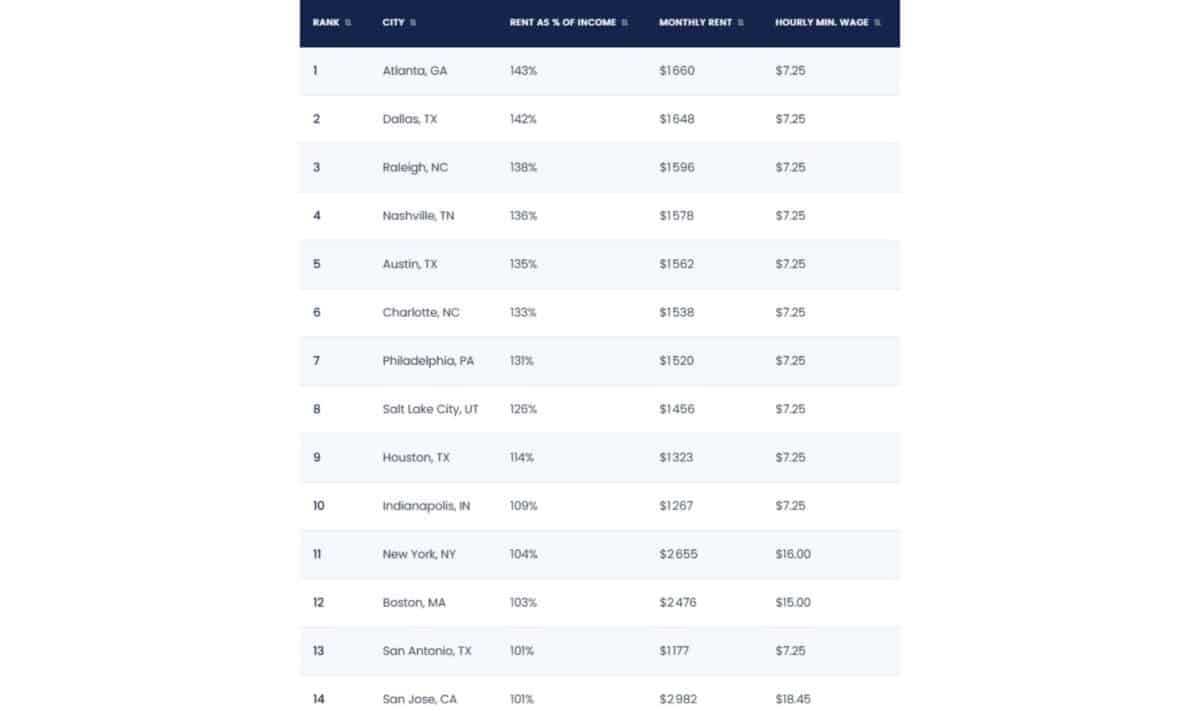
Atlanta recorded the widest rent-to-income imbalance among the seven cities highlighted in the analysis. Fair market rent for a one-bedroom apartment is $1,660 a month, equal to 143% of a worker’s $1,160 monthly minimum-wage income. The resulting monthly shortfall is $500. Dallas follows closely. According to the Best Interest Financial study, its one-bedroom fair market rent is $1,648, or 142% of monthly minimum-wage earnings, leaving workers $488 short before accounting for food, transportation, utilities or other expenses.
The pattern continues in Raleigh, where rent reaches $1,596 and consumes 138% of gross monthly minimum-wage income. Nashville follows at $1,578, or 136%, while Austin records rent of $1,562, equivalent to 135%. Charlotte’s one-bedroom fair market rent stands at $1,538, consuming 133% of a minimum-wage worker’s monthly income. Philadelphia reaches $1,520, or 131%. Each of these cities pays workers at the federal minimum of $7.25 an hour.
The figures also show how many working hours would theoretically be needed to meet rent. Atlanta requires 191 hours of minimum-wage work per week, while Dallas requires 189. Raleigh requires 183 hours, Nashville 181, Austin 180, Charlotte 177 and Philadelphia 175.
Higher Local Minimum Wages Are Associated with Smaller Rent Burdens
The study found a clear difference between cities using the federal minimum wage and places where workers receive higher local or state wage floors. Of the 14 cities where monthly rent exceeds monthly minimum-wage earnings, 11 pay workers $7.25 an hour.
By contrast, 30 of the 36 cities where monthly minimum-wage earnings exceed one-bedroom rent pay more than the federal minimum. According to Best Interest Financial, St. Louis has the lowest rent burden in the study: workers earn $15 an hour and face fair market rent of $995, equal to 41% of gross monthly income.
Kansas City, where the minimum wage is also $15, records rent of $1,197, representing 50% of income. Fresno is the only other city where rent accounts for 50% or less of minimum-wage earnings.
Even those markets remain above the widely used 30% affordability threshold. Across all 50 metropolitan areas examined, the study found no city where a single full-time minimum-wage worker could rent a one-bedroom apartment while keeping housing costs within that benchmark.