
Nearly a dozen cities across California will raise their minimum wage rates from July 1 as new local ordinances come into force, pushing hourly pay as high as $20.34 in some areas and affecting millions of workers across the state.
Wage Increases Across Multiple Cities
The changes come as part of annual adjustments in several California cities and counties where local minimum wage rules are linked to inflation and cost-of-living indicators rather than relying solely on the state minimum wage.
Although California’s statewide minimum wage has recently increased to $16.90 per hour, many cities apply higher local rates that will rise again from July 1 under automatic adjustment systems.
These local systems are designed to reflect changes in living costs and ensure wages keep pace with regional economic conditions, particularly in urban areas where expenses are higher than the state average.
Cities And New Pay Levels
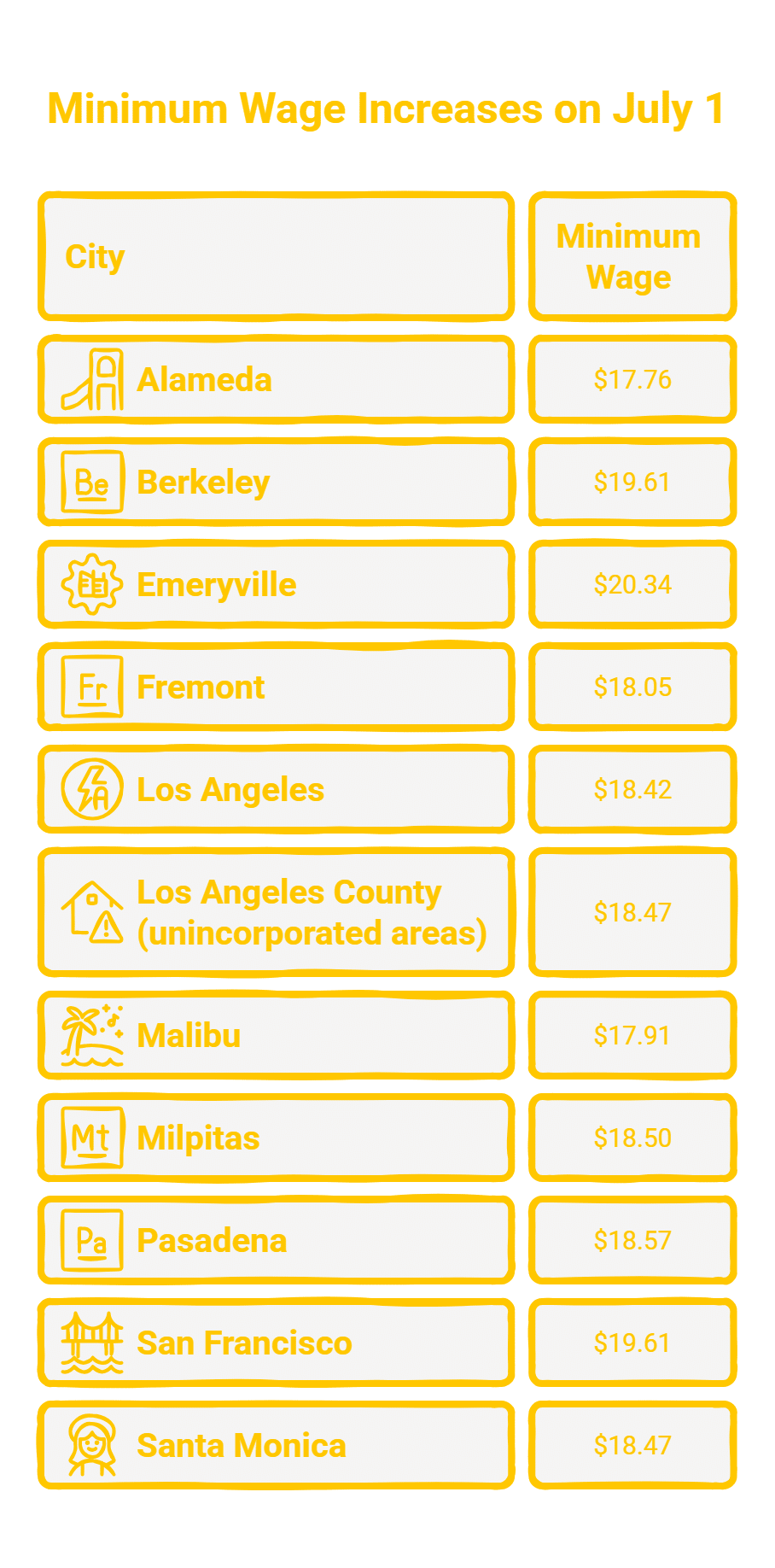
Eleven cities and counties will see increases to their minimum wage rates from July 1 as part of the latest adjustment cycle. Alameda will see its minimum wage rise to $17.76 per hour, while Berkeley will increase to $19.61. Emeryville will reach $20.34 per hour, remaining one of the highest local wage floors in the state.
Fremont will increase to $18.05 per hour, while Los Angeles will rise to $18.42. Los Angeles County’s unincorporated areas will increase to $18.47 per hour. Malibu will move to $17.91 per hour, Milpitas to $18.50, Pasadena to $18.57, San Francisco to $19.61 and Santa Monica to $18.47 per hour.
How Local Wage Systems Work
Many of the affected cities use automatic annual adjustment mechanisms tied to inflation or cost-of-living indexes. This means wages are updated each year without requiring separate legislative action at state level.
Local authorities argue this approach helps maintain purchasing power for workers in areas where housing, transport and essential goods remain more expensive than in other parts of the state. As a result, wage levels can vary significantly between neighbouring cities depending on local policy frameworks.
Broader California Policy Changes
The wage increases are part of a wider set of laws taking effect across California from July 1, covering employment, education and public services. New rules include restrictions on smartphone use in schools, updated safety requirements for student identification cards, and new infrastructure requirements for educational facilities.
Schools serving grades 1 to 12 will also be required to provide at least one gender-neutral restroom on site under the new regulations.
Regional Economic Context
California continues to operate a dual structure in which a statewide minimum wage sets a baseline while local governments apply higher rates in selected areas. This system has created a patchwork of wage levels across the state, particularly in major urban centres where living costs remain significantly higher.
The latest increases reinforce this trend, with several of California’s largest cities once again raising hourly pay levels for workers across key service sectors.