
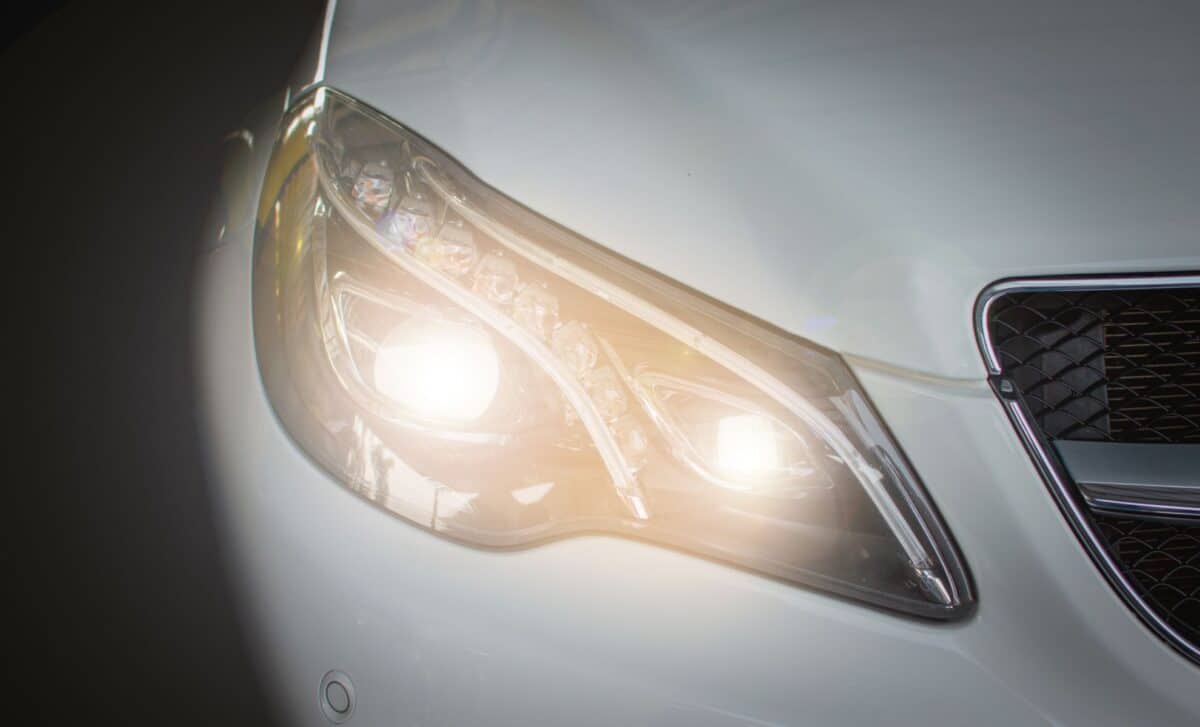
The change affects four classes of vehicles and follows work involving the Department for Transport, the DVSA and lighting manufacturers. It introduces a way for MOT testers to identify approved replacement bulbs, while retaining restrictions on products that do not meet the required standards.
Four Vehicle Classes Covered by the New Headlight Rules
The updated MOT guidance applies specifically to vehicles fitted with ECE-approved LED replacement (LEDr) bulbs in existing halogen headlamp units. According to The Independent, the new requirements cover Class 3, Class 4, Class 5 and Class 7 vehicles.
These categories include tricycles under Class 3, cars and other qualifying vehicles under Class 4, larger passenger vehicles within Class 5, and goods vehicles covered by Class 7.
The change does not extend to every vehicle or headlight modification. Class 1 and Class 2 motorcycles remain excluded, as do halogen headlamp units converted to use high-intensity discharge (HID) bulbs and complete LED headlamp replacements.
The distinction also applies to the replacement bulbs themselves. Not every LED bulb marketed as a substitute for a halogen product qualifies under the revised guidance. Only ECE-approved LED replacement products are covered.
According to GB News, automotive lighting manufacturer Osram worked with the Department for Transport and DVSA for two years on the changes. The revised wording reflects developments in replacement bulb technology and aims to address uncertainty surrounding their acceptance during MOT inspections.
Carl Harrison, Osram’s product manager for bulbs and vehicle lighting, said there had been considerable work behind the scenes to introduce the revised requirements. “There has been a lot of confusion on this subject for years, but with this change, we are moving forward with the technology on our roads and helping to keep drivers safe,” he said.
Approval Stickers Determine Whether Replacement Bulbs Pass Inspection
Under the revised procedure, vehicles using qualifying LED replacement bulbs must carry a secure approval sticker. This must be permanently attached somewhere easily visible to an MOT tester, with the engine bay identified as one suitable location. The sticker must display six pieces of information: the bulb category, such as H11 LEDr; its variant; rated voltage; ECE approval number; manufacturer’s name; and a security feature, such as a hologram.
Manufacturers may use different sticker designs, provided the required information and security feature are included. During an MOT inspection, testers are not required to verify approval numbers, manufacturer details or approval markings against external databases or documentation. Their responsibility is to check the sticker and its suitability for the fitted bulb.
A vehicle will fail if the sticker is missing, illegible, appears to have been tampered with or does not correspond to the installed bulb. Testers can record the major defect as “light source and lamp not compatible”.
Grant Thunder, head of MOT at the DVSA, said the approach would help inspectors identify approved replacement light sources. “This will make sure that those fitted with non-approved LED light sources continue to fail their MOT test,” he explained. The new procedure therefore allows qualifying LED replacements to be accepted while maintaining MOT failures for non-approved products.