
HM Revenue and Customs (HMRC) has confirmed a £60,000 income threshold rule for the 2026/27 tax year, meaning some households claiming Child Benefit will face an additional tax charge if earnings exceed the limit. The rule applies under the High Income Child Benefit Charge (HICBC) and affects families where either partner earns above the threshold.
Child Benefit Rule and £60,000 Threshold
Under the system, households receiving Child Benefit must repay part or all of it if one partner earns more than £60,000 per year. The repayment increases gradually, with families required to pay back 1% of their Child Benefit for every £200 earned above the threshold.
Once household income reaches £80,000 or more, the full amount of Child Benefit must be repaid to HMRC. Where both partners exceed the threshold, the responsibility for paying the charge falls on the higher earner.
HMRC defines a partner as someone you are married to, in a civil partnership with, or living with as if married and not permanently separated.
How the High Income Child Benefit Charge Works
HMRC confirmed that from the 2024/25 tax year onwards, the £60,000 threshold applies consistently. The charge ensures that Child Benefit is gradually reduced for higher earners rather than being fully withdrawn at a single point.
For example, if a household has an adjusted net income of £67,600, this is £7,600 above the threshold. Dividing that figure by £200 results in 38, meaning 38% of the Child Benefit must be repaid.
Families can either continue receiving Child Benefit and pay the charge through PAYE or Self Assessment, or opt out of payments entirely to avoid the tax charge.
HMRC Warning Over Pay Rises
HMRC has also warned that recent pay rises could push more households over the £60,000 threshold, potentially triggering the charge. The agency has advised parents to check their income carefully if their earnings have recently increased.
In a statement, HMRC said households earning above £60,000 who receive Child Benefit “may need to pay some of it back” and encouraged users to access its online High Income Child Benefit Charge service for guidance.
Child Benefit Rates Increase
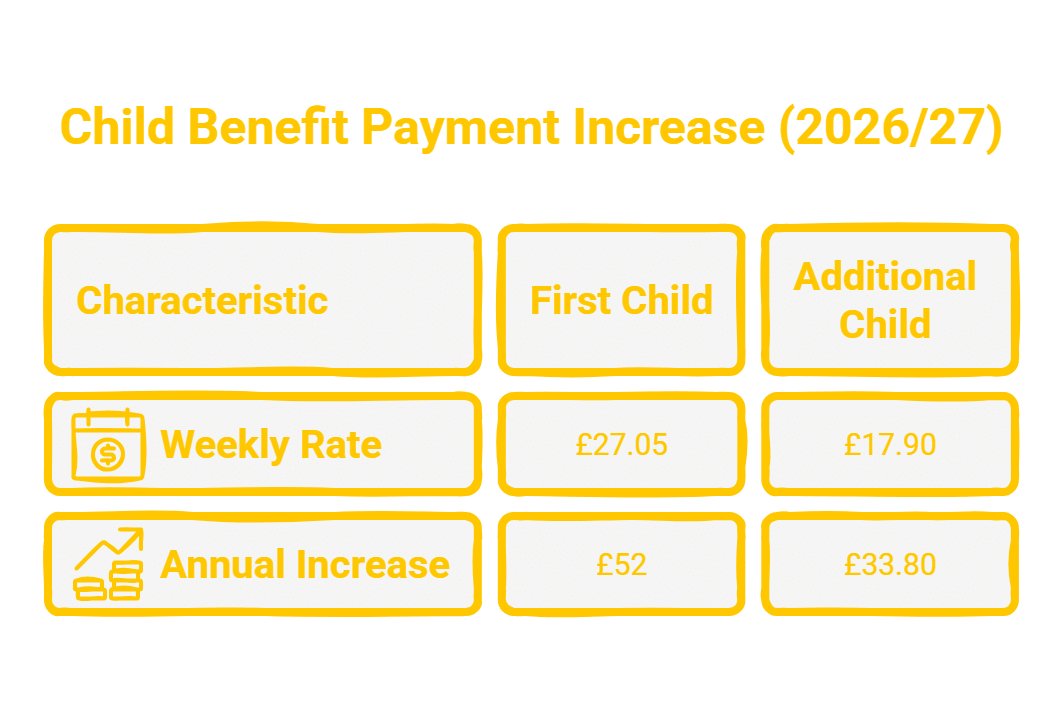
Alongside the threshold rule, Child Benefit payments have increased by 3.8% for the 2026/27 tax year. The weekly rate is now £27.05 for the first child and £17.90 for each additional child, representing annual increases of £52 and £33.80 respectively.
Over a year, this equates to £1,406.60 for the first or only child, plus £930.80 for each additional child, with no limit on the number of children eligible for support.
What Households Need to Know
The combination of rising Child Benefit payments and income-linked repayment rules means more families could be affected by the HICBC in the coming tax year. HMRC continues to encourage households to review their earnings and assess whether they may fall within the repayment threshold.