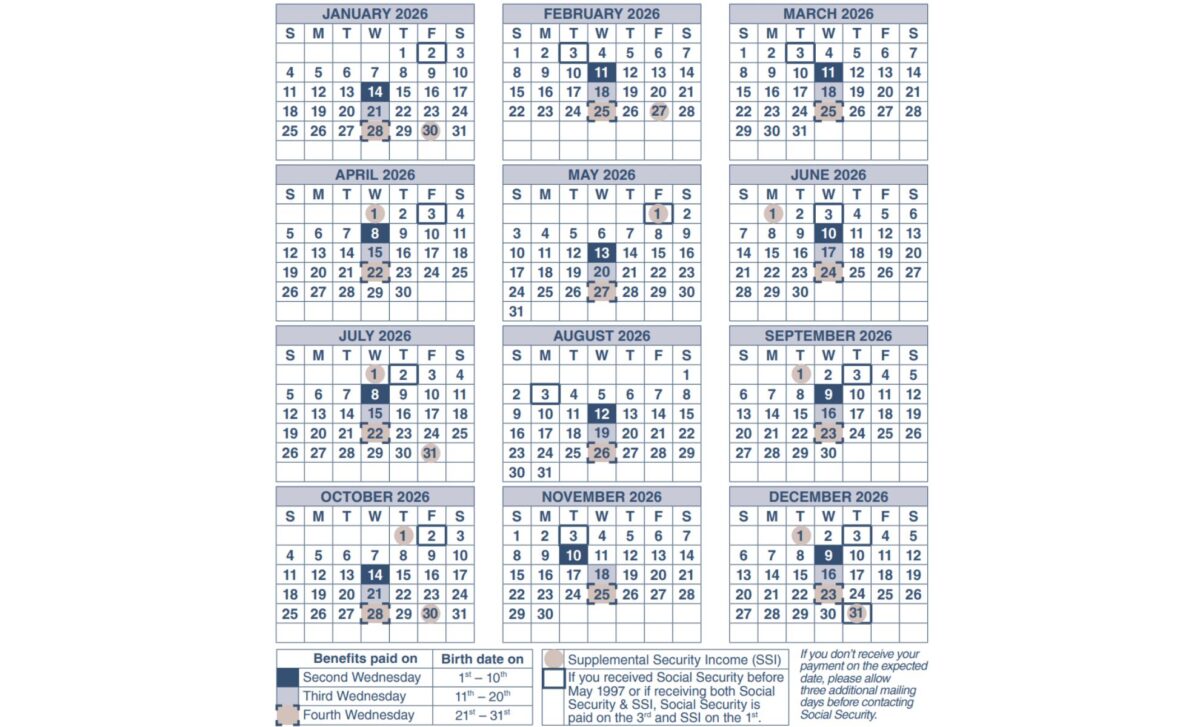
Social Security payments for September 2026 will be distributed across five dates, beginning with Supplemental Security Income on September 1 and ending with the final scheduled Social Security payment on September 23. The timetable depends on the type of benefit a person receives, when they first began collecting benefits, and, for many recipients, their date of birth.
The schedule affects tens of millions of Americans receiving retirement, survivor, spousal and disability benefits, while Supplemental Security Income, or SSI, follows a separate timetable. The payments arrive as beneficiaries also await the 2027 cost-of-living adjustment, which is expected to be announced in October after September inflation figures are released.
September Payments Will Be Spread Across Five Dates
According to reports, SSI recipients are scheduled to receive their September payment on Tuesday, September 1. Beneficiaries who started receiving Social Security before May 1997, as well as people who receive both Social Security and SSI, are due to be paid on Thursday, September 3.
The remaining Social Security payments will follow the usual birthday-based schedule. Beneficiaries born between the 1st and 10th of a month will be paid on Wednesday, September 9. Those with birthdays between the 11th and 20th are scheduled for Wednesday, September 16, while recipients born between the 21st and 31st will receive their payments on Wednesday, September 23. If a scheduled payment does not arrive, the Social Security Administration advises beneficiaries to wait three working days before contacting the agency.
Payment amounts vary according to factors including a beneficiary’s earnings history and the type of benefit received. According to the latest SSA data, 71.3 million people received Social Security benefits in July 2026. The average monthly payment across all beneficiaries was $1,940.08.
Retired workers, the largest group of recipients, received an average monthly payment of $2,085.98, while disabled workers received an average of $1,635.27. Another 7.3 million people received SSI in July, with an average monthly payment of $736.54. Because some people receive benefits from both programs, those populations cannot simply be added together. Overall, 75.7 million people were receiving Social Security, SSI or both that month.
Attention Is Shifting Toward the 2027 Cost-Of-Living Adjustment
Many beneficiaries are now waiting for the 2027 cost-of-living adjustment, or COLA. The adjustment is calculated using the Consumer Price Index for Urban Wage Earners and Clerical Workers, known as the CPI-W.
The SSA compares the average CPI-W reading for July, August and September with the average from the same three-month period a year earlier. The resulting percentage increase becomes the following year’s COLA. According to reports, Only July’s figure, 3.4 percent, was available when the report was published, leaving the final 2027 adjustment uncertain. The SSA is due to announce the official figure in October after September inflation data are released.
The Senior Citizens League was projecting a 3.6 percent COLA for 2027, down from its earlier 3.8 percent forecast, while AARP had lowered its estimate to 3.5 percent from 3.6 percent. The 2026 COLA was 2.8 percent.
September’s payments also come amid continued attention to Social Security’s long-term finances. The latest Social Security Trustees report projects that the Old-Age and Survivors Insurance Trust Fund will exhaust its reserves in the fourth quarter of 2032 without congressional action, after which incoming revenue would cover an estimated 78 percent of scheduled benefits.