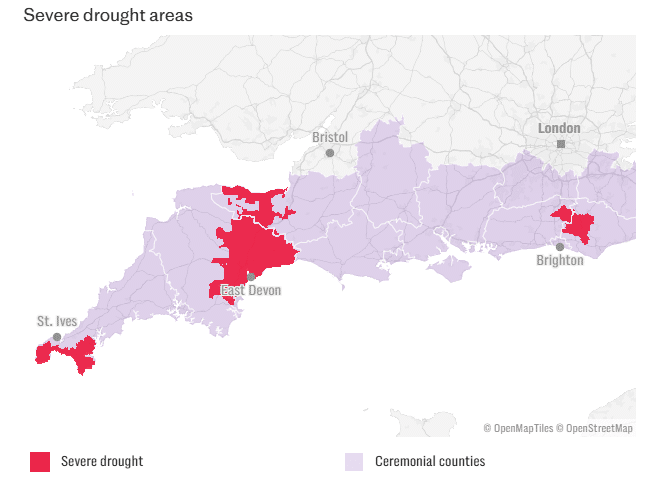
Thousands of households in southwest England could face three consecutive days without running tap water under emergency drought plans being prepared in Devon, where depleted reservoirs have raised concerns about supplies heading into 2027.
Emergency Water Restrictions Could Affect Thousands of Homes
According to The Independent, Devon authorities are preparing for a potential stage four severe drought, the most serious classification under the Environment Agency’s framework.
Around 60 organizations, including local councils and emergency services, are involved in contingency planning alongside South West Water (SWW).
Under the proposed system, households and businesses could receive water on a rotating schedule, potentially alternating between three days with running water and three days without it.
The arrangements remain contingency measures rather than confirmed restrictions.
Wimbleball Reservoir, which supplies drinking water to approximately 400,000 people in Devon, stood at just 13% capacity in October. Its level has since recovered to around 20%, still substantially below normal seasonal storage.

Officials Warn That Vulnerable Residents Could Be at Risk
The prospect of prolonged water interruptions has raised concerns about the county’s ability to protect residents requiring continuous access to clean water.
Richard Keeling, Devon County Council’s cabinet member for adult services, warned:
“I have very real concerns about what planning for cut-offs would actually mean.”
“I’m worried about all our care homes and the 33,000 vulnerable people we have in our care whom we would have to supply with water.”
Council leader Julian Brazil also criticized the emergency planning process, accusing South West Water of years of inadequate preparation.
Blaming “decades” of “South West Water’s neglect,” Brazil told The Telegraph that the council had initially been excluded from discussions.
“We’re angry here at the council. What happened was COBRA and SWW were having emergency meetings and as always we were excluded.”
“But we are the ones who have to implement these plans, so we will have to step in to clear up their mess despite only recently having had sight of what they look like.”
“They were discussed privately in a smoke-filled room, another example of the government being complicit in putting water companies and private interests first rather than the public and customers in Devon.”
Brazil also highlighted practical difficulties:
“The plan is a pretty bog standard one but there are logistical problems, like how to get people bottled water, all the stuff we have to do that we were initially not told for whatever reason.”
Water Company Faces Criticism as Reservoirs Remain Depleted
The preparations have prompted political criticism over South West Water’s management and shareholder payments.
Richard Tice, Reform UK’s deputy leader, told The Telegraph that SWW “is a national embarrassment”.
“While families endure sewage-soaked rivers, severe droughts, and now this farcical tap rota, the company has handed £200m in dividends to its shareholders in just two years,” he said.
“Residents are being let down by failed management and a failed regulator. Reform will fix this.”
The drought follows Britain’s hottest summer on record, which left reservoirs across southern England severely depleted.
The Environment Agency has warned that England needs rainfall reaching approximately 120% of its seasonal average to recover from drought conditions by spring.
Government Says Water Rationing Is Not Planned
Despite the emergency preparations, the UK government insists that water restrictions are not expected.
A spokesperson for the Department for Environment, Food and Rural Affairs (Defra) stated:
“There are no plans for water rationing, and we do not anticipate any impact on public water supplies.”
“The Government and Environment Agency continue to act to protect water supplies across the country, and it’s right that water companies in the areas of severe drought have contingency plans, alongside daily monitoring of reservoir and river levels.”
“Our new regional water councils will give communities a say in how water is managed in their area, so that water companies are made to face the people and communities they serve.”
South West Water has also confirmed that rotating shutoffs will not be needed this winter, describing the arrangements as a last-resort measure.
The company continues repairing leaks, transferring water across its network and working with authorities on emergency preparations.
Meanwhile, river water has already been used to replenish reservoirs, and Wimbleball Reservoir remains at approximately 20% capacity.