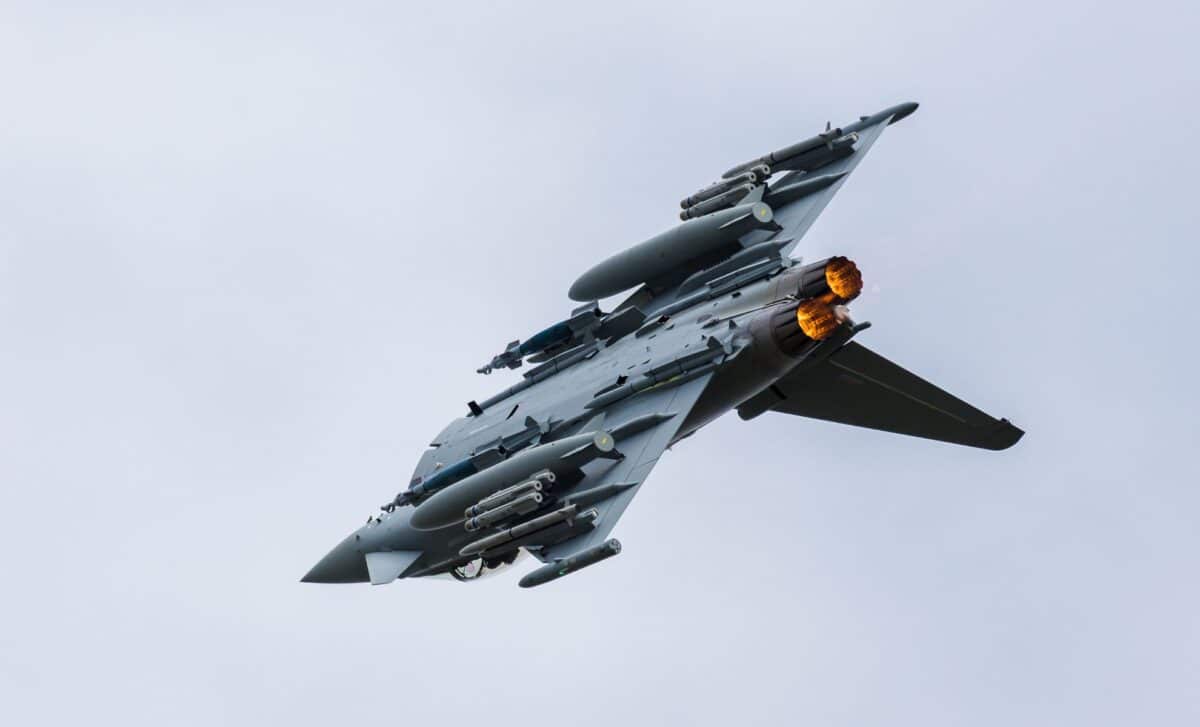
The United Kingdom has tested a new low-cost weapon on its Eurofighter Typhoon, aiming to address the growing challenge posed by mass-produced drones. The trial marks a step toward reducing reliance on expensive air-to-air missiles for relatively simple aerial threats. The development reflects a broader change in military thinking, where cost and sustainability are becoming as important as performance. As drone warfare expands, air forces are under pressure to adapt quickly without exhausting high-value resources.
A New Role for Typhoon in Counter-Drone Operations
BAE Systems confirmed on April 8, 2026, that a Royal Air Force Typhoon successfully fired an APKWS laser-guided rocket during a test at a UK military range. The trial involved a strike on a ground-based target and was conducted from the company’s facility in Warton, Lancashire.
According to BAE Systems, the test is part of a wider effort to expand Typhoon’s capabilities, particularly in countering uncrewed aerial systems. The APKWS system is not a standalone weapon but a guidance kit that converts standard 70 mm rockets into precision-guided munitions. It works by adding a laser-guidance section between the rocket motor and warhead, allowing the munition to track a designated target.
The Typhoon already carries a wide range of advanced weapons, including Meteor air-to-air missiles and Storm Shadow cruise missiles. The addition of APKWS does not replace these systems but introduces a lower-cost option for targets that do not justify the use of more expensive interceptors.
According to reporting from The War Zone, the next phase of testing will focus on engaging airborne targets, which presents different technical challenges compared to ground strikes. A proximity-fuzed variant of the rocket, known as FALCO, is expected to play a role in this stage, particularly for intercepting drones.
The aircraft is already equipped with targeting pods capable of laser designation, meaning integration of the APKWS system builds on existing infrastructure. This reduces the complexity of adoption and allows for faster operational deployment if further tests prove successful.
Cost Pressures Drive Adoption of Cheaper Interception Methods
The trial comes at a time when air forces are increasingly confronted with the economic imbalance of modern warfare. Drones used in recent conflicts can cost tens of thousands of dollars, while the missiles used to intercept them often cost hundreds of thousands or more.
According to The War Zone, an AIM-120 AMRAAM missile can cost around $1 million, while an AIM-9X Sidewinder is priced at roughly $450,000. In contrast, the APKWS guidance kit typically costs between $15,000 and $20,000, with additional components such as rocket motors adding a relatively small amount.
This cost difference has practical implications. A standard APKWS pod can carry seven rockets, allowing a Typhoon to engage multiple targets in a single sortie. Images released by BAE show configurations with two pods, providing up to 14 rockets while still leaving room for traditional air-to-air missiles.
According to Army Recognition, the growing use of drones in conflicts such as Ukraine and the Middle East has accelerated the search for affordable interception solutions. In some cases, large numbers of low-cost drones are used to overwhelm defenses, forcing defenders to expend high-value munitions at an unsustainable rate.
The APKWS system has already seen operational use on platforms such as the F-16, A-10, and F-15, with hundreds of successful engagements reported since its introduction. BAE Systems has also indicated that production has scaled significantly, with tens of thousands of units delivered and capacity for continued output.
For the RAF and other Typhoon operators, the outcome of future air-to-air tests will be decisive. A successful transition from ground trials to aerial interception could provide a practical and scalable response to one of the most persistent challenges in modern air combat.