
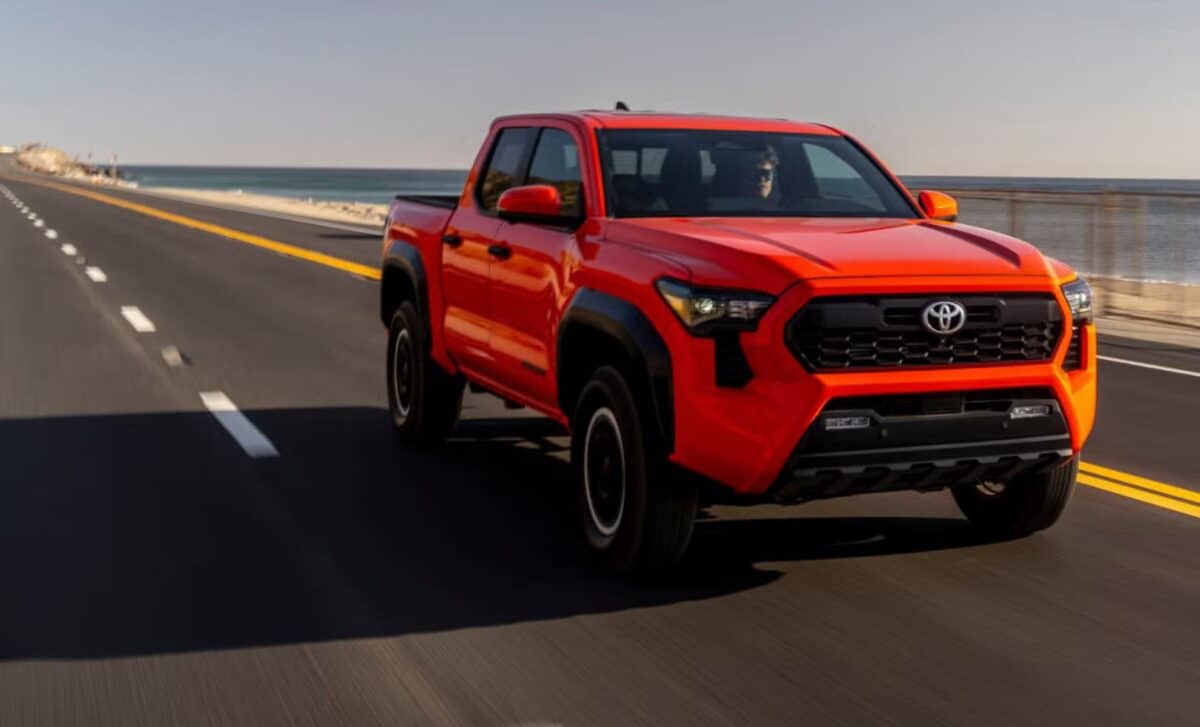
Nearly 48,000 Toyota Tacoma TRD Off-Road pickups from the 2024 and 2025 model years are being recalled because components attached to their shock absorbers can corrode, separate from the vehicle, and potentially fall onto the road. The defect can also lead to shock-oil loss, raising concerns about reduced damping performance and vehicle stability until affected assemblies are repaired.
Why Toyota Is Recalling Nearly 48,000 Tacoma Pickups
The recall centers on the suspension fitted to certain 2024–2025 Toyota Tacoma TRD Off-Road models, a version of the midsize pickup designed specifically for drivers who expect more capability away from paved roads.
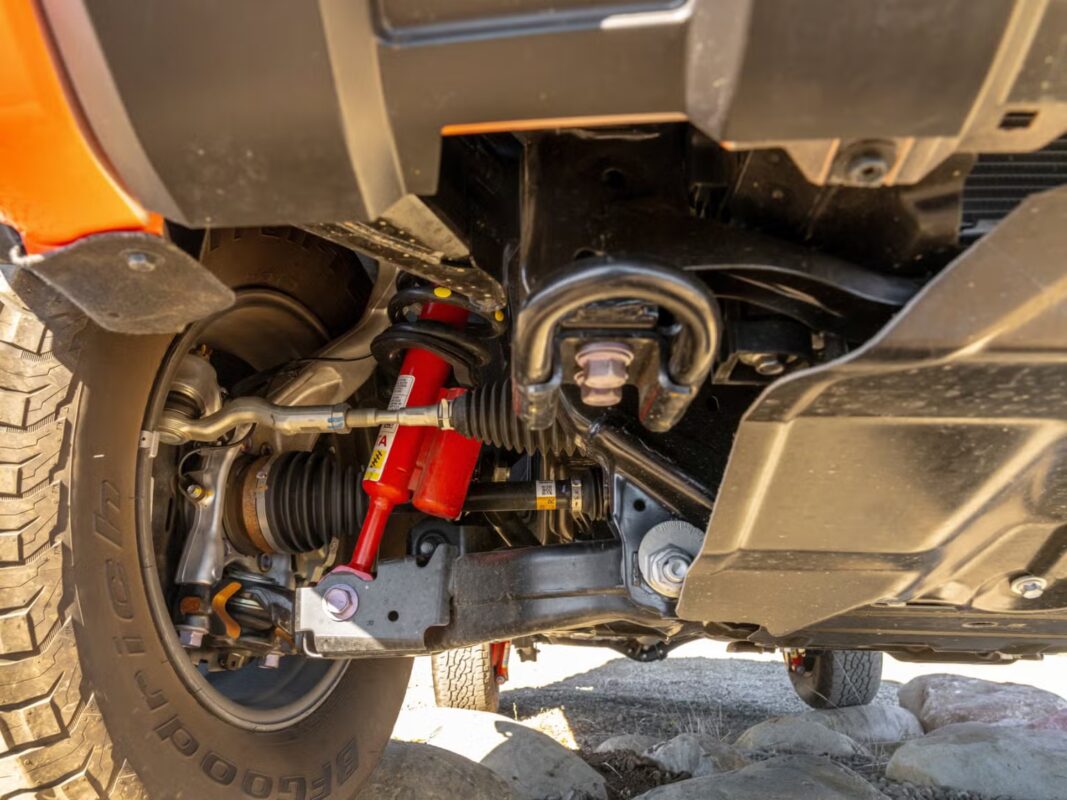
According to Toyota, corrosion can develop in a way that allows the oil reservoir associated with a shock absorber to detach. That creates two distinct safety concerns. A reservoir that separates completely can become debris in the roadway, where it could present a hazard to motorists, motorcyclists, cyclists, or other road users.
The problem can also affect the truck itself. If a reservoir becomes detached, shock oil may escape from the assembly. Losing that fluid can reduce the shock absorber’s ability to control suspension movement, potentially changing the way the vehicle responds on uneven surfaces or during demanding maneuvers.
Toyota is conducting the campaign as a voluntary safety recall, with approximately 48,000 vehicles included. At the time the recall was initially reported, the campaign had not yet appeared in the National Highway Traffic Safety Administration (NHTSA) recall database.
That timing distinction matters for owners searching government records immediately after the announcement. Toyota owners can use their vehicle identification number, or VIN, through Toyota’s recall-checking resources, while the federal database can be checked as the campaign information becomes available there.
Toyota has not issued a “Do Not Drive” advisory, meaning the recall does not amount to an instruction that every affected truck must immediately be parked. Owners should still arrange the prescribed inspection and repair when their vehicle is identified as part of the campaign.
Credit: Toyota
The Problem Involves Hardware Designed For Serious Off-Road Use
The Tacoma TRD Off-Road uses Bilstein monotube remote-reservoir shock absorbers, hardware intended to support the model’s more demanding mission.
A remote reservoir provides additional capacity for shock fluid and can help manage heat as the suspension repeatedly compresses and rebounds. That is particularly relevant during off-road driving, where rough surfaces can force the suspension to work harder and more frequently than it typically would during ordinary highway travel.
The Tacoma’s suspension is therefore more than a comfort feature. Shock absorbers help control the movement of the wheels and body after the suspension encounters bumps, dips, rocks, and other changes in the road or trail surface. Proper damping keeps those movements controlled rather than allowing the vehicle to continue bouncing excessively.
That explains why oil loss from an affected shock assembly deserves attention even if the reservoir does not strike another road user. Reduced damping can alter suspension behavior and potentially influence vehicle stability.
The risk is especially relevant to a truck marketed for off-road use, since its suspension may regularly experience large movements and repeated impacts. Owners waiting for repairs may therefore want to account for the potential defect when deciding how aggressively to drive their vehicles, particularly on demanding terrain.
The recall does not mean that every one of the roughly 48,000 trucks will necessarily experience a reservoir separation. A safety recall identifies vehicles that may contain the relevant defect and establishes a process for inspecting and correcting the condition before it results in a safety incident.
Dealers Will Inspect Both Front And Rear Shock Assemblies
Toyota’s repair plan calls for owners to bring affected trucks to an authorized dealer, where technicians will inspect the front and rear shock-absorber assemblies.
If an assembly is determined to be affected, it will be replaced with an improved unit. The inspection and necessary replacement work will be performed at no cost to owners, consistent with the manufacturer’s recall remedy.
Toyota expects to notify affected customers by early October 2026. Owners do not necessarily need to wait for a mailed notification before checking whether their Tacoma is involved.
A VIN provides the most precise way to determine whether an individual vehicle falls within a recall population. This is particularly useful because recall campaigns can cover only certain production periods or configurations within a broader model year.
Owners can check through Toyota’s recall system or the NHTSA recall database. Toyota’s Brand Engagement Center can also be reached at 1-800-331-4331 for additional information.
The automaker had not specified whether the affected population was restricted to a particular Tacoma powertrain in the information available when the campaign was reported. That makes a VIN check more useful than relying solely on engine type when determining whether a particular truck requires attention.
Both Turbo And Hybrid Powertrains Are Available In The TRD Off-Road
The current-generation Tacoma represents a substantial redesign of Toyota’s long-running midsize pickup, and the TRD Off-Road trim can be configured with different powertrain options.
Depending on configuration, buyers can get Toyota’s 2.4-liter i-Force turbocharged engine or the electrified i-Force Max hybrid powertrain.
The i-Force Max system produces up to 326 horsepower and 465 lb-ft of torque, giving the hybrid Tacoma substantial low-end output for a midsize truck. The combination of that performance with dedicated off-road suspension equipment is part of the TRD Off-Road’s positioning within the broader Tacoma range.
The recall, though, concerns the shock-absorber assemblies rather than a reported defect in either powertrain.
That distinction is useful for owners because the mechanical issue is concentrated in suspension hardware. The remedy described by Toyota does not call for engine or hybrid-system modifications; technicians will instead inspect the relevant shock assemblies and replace affected units.
Until Toyota’s vehicle-specific recall information confirms whether a truck is involved, owners of 2024 or 2025 TRD Off-Road models should not assume that a particular engine configuration automatically includes or excludes their vehicle.
Using the VIN remains the clearest way to establish recall status and determine whether dealer service is required.