
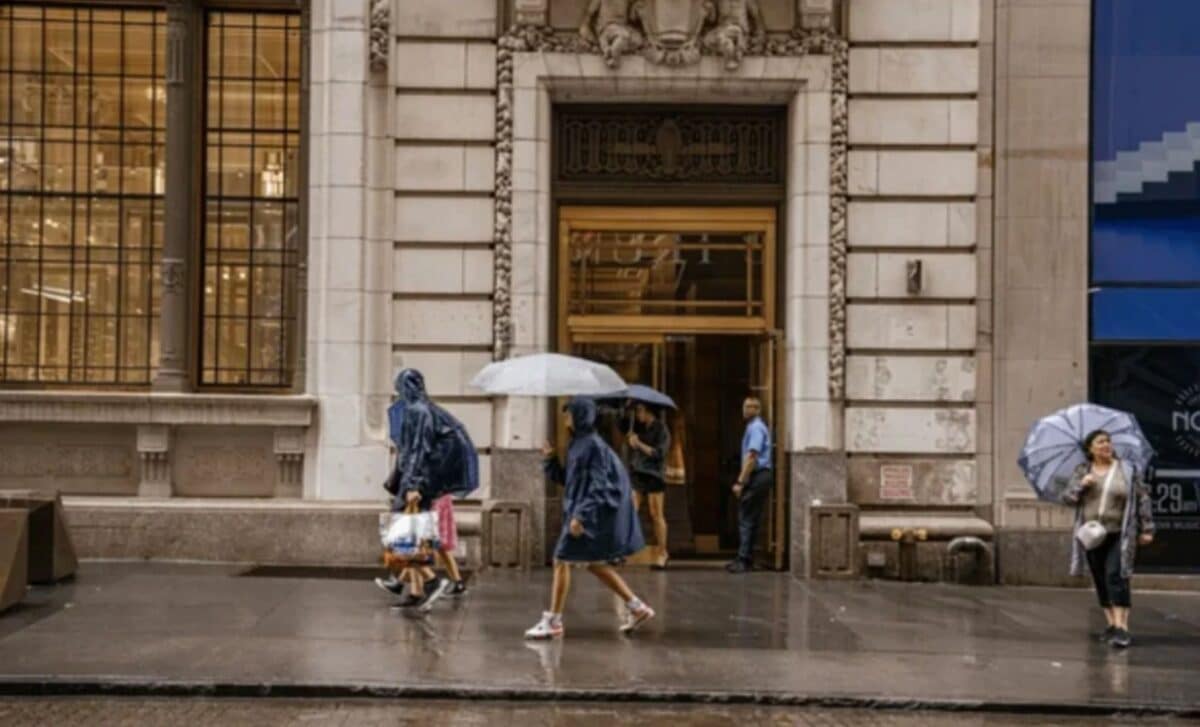
The severe weather also forced New York City to postpone the 100th Macy’s Thanksgiving Day Parade until Saturday, marking the first weather-related postponement in the event’s history. Emergency declarations were issued across New Jersey and parts of New York as authorities responded to widespread flooding and hazardous travel conditions.
Strong Winds and King Tides Drive Widespread Flooding
According to the National Weather Service (NWS), strong onshore winds combined with king tides to push seawater into low-lying communities along the Eastern Seaboard. Coastal towns from North Carolina to New Jersey experienced flooding, road closures, and emergency rescue operations.
Water levels reached historic marks in several locations. NBC News reported that Wachapreague, Virginia, recorded a new high of 9.94 feet, surpassing the level measured during Hurricane Sandy in 2012 by 1.5 feet. Cape May, New Jersey, matched its previous record of 9.41 feet.
In Avalon, New Jersey, floodwaters carried debris onto coastal roads, leaving several motorists stranded. Emergency workers rescued drivers who had entered flooded areas, although local officials reported no injuries.
New York City received between 1.5 and 2 inches of rain, with some areas recording up to 3 inches. Central Park experienced its wettest Thanksgiving on record, registering 1.82 inches of rainfall and exceeding the previous record set in 2006.
Wind speeds reached 56 mph at LaGuardia Airport on Thursday afternoon. Several scaffolding structures collapsed across the city, while flooding affected coastal sections of Staten Island and Long Island.
In Virginia, high winds forced the temporary closure of the Chesapeake Bay Bridge-Tunnel. North Carolina’s NC 12 highway was also closed after seawater breached coastal dunes and covered the roadway.
Power Outages and Travel Disruptions Extend Beyond the East Coast
According to PowerOutage.us cited by France24, 961,000 utility customers nationwide were without electricity at 7:30 p.m. Eastern Time on Thursday. That number fell to more than 908,000 by 9:56 p.m. and remained above 700,000 early Friday morning.
Pennsylvania recorded more than 207,000 outages on Thursday night, followed by New Jersey with over 179,000, Maryland with 139,000, and Virginia with 106,000.
Power disruptions also affected water infrastructure. In Maryland, the Washington Suburban Sanitary Commission asked its 1.9 million customers to conserve water after intermittent electricity disruptions affected two filtration facilities.
Meanwhile, heavy snowfall created additional problems across the Midwest. St. Louis, Missouri, recorded 7.3 inches of snow, while Ste. Genevieve received 14 inches. In Wentzville, the roof of an ice arena partially collapsed during the snowstorm. The building was empty at the time.
Air travel was similarly affected. FlightAware recorded 2,561 delays and 462 cancellations involving flights within, into, or out of the United States on Thursday. Airports serving Washington and New York were among those hardest hit.
The National Weather Service expected conditions across the Mid-Atlantic to gradually improve overnight as the heaviest rainfall and strongest winds moved into New England. Gusty conditions were still forecast across parts of the East Coast on Friday, with hundreds of thousands of utility customers awaiting the restoration of electricity.