

Most major U.S. cities have experienced warmer summers over the past five decades, but the strongest increases have been concentrated in the West and Southwest. Researchers found that 97 percent of the 243 cities examined have warmed since 1970.
Climate Central’s analysis, published on May 20, compared average temperatures during June, July, and August between 1970 and 2025. The study identified Reno as the fastest-warming city for summer temperatures, followed by Boise, Idaho, and El Paso, Texas, both of which recorded increases of 6.3 degrees Fahrenheit.
Las Vegas and Salt Lake City rounded out the top five, with summer temperatures rising by 6.2 and 6.0 degrees respectively. The findings highlight a broader warming trend that has affected nearly every major urban area included in the dataset.
Western Cities Show the Largest Increases in Summer Heat
According to Climate Central, summer warming has been strongest on average across the Northwest, Southwest, and South. Reno emerged as a notable outlier, recording an 11.3-degree Fahrenheit increase in average summer temperatures since 1970, nearly double the rise observed in the next-highest cities.
Vivek Shandas, a professor of geography at Portland State University, told Newsweek that cities such as Reno and Boise are experiencing what he described as a “double exposure.” He said broader regional climate warming is occurring alongside rapid urban development, which can intensify local heat conditions.
“The western United States has experienced some of the most rapid warming in North America over the past several decades,” Shandas said. He added that inland locations are often more exposed because they do not benefit from the moderating influence of the Pacific Ocean.
Shandas also noted that many fast-growing cities in arid and semi-arid regions have expanded substantially since the 1970s. According to his comments, roads, parking lots, commercial areas, and residential developments have increasingly replaced landscapes that previously provided cooling through shade and evaporation.
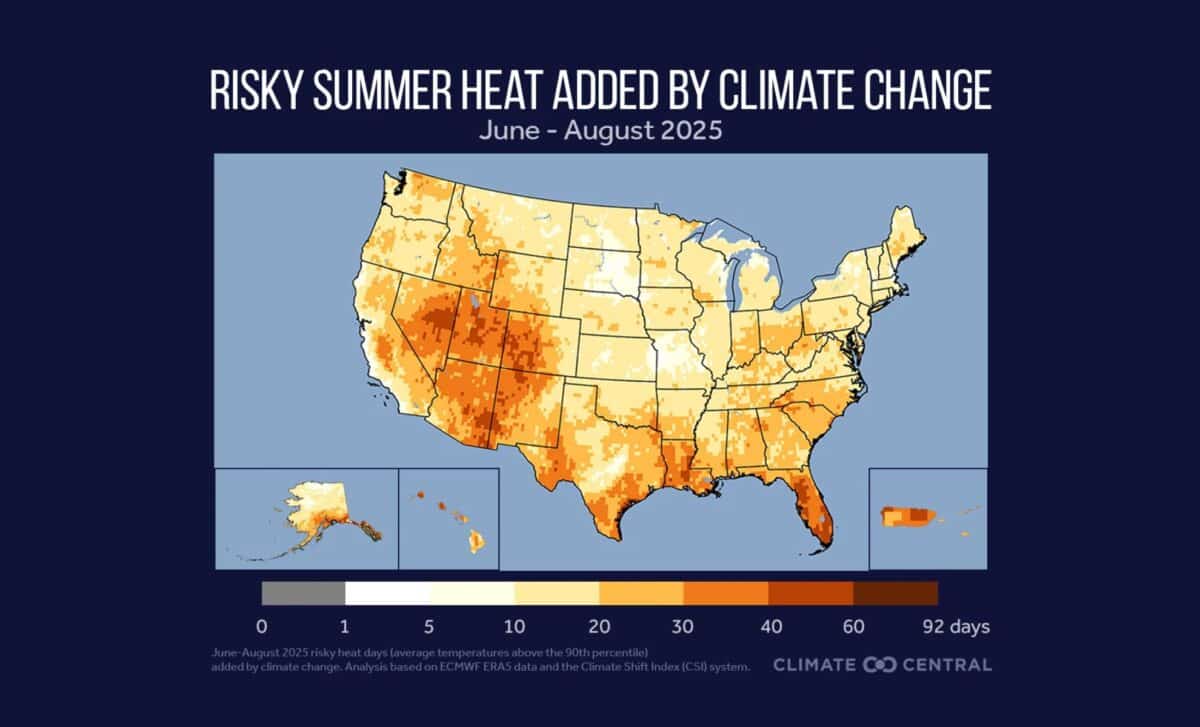
Climate Central further reported that human-caused climate change was the leading driver of summer warming in 221 of the 243 cities analyzed, representing about 91 percent of the locations included in the study.
Rising Temperatures Bring Growing Public Health Concerns
The broader dataset shows that warming has not been limited to a handful of western cities. According to Climate Central, average summer temperatures increased by 2.6 degrees Fahrenheit across the 236 cities where warming was observed.
The organization also found that cities now experience an average of 22 more hotter-than-normal summer days compared with the early 1970s. New York City, for example, recorded an increase of approximately 1.2 degrees Fahrenheit over the same period.
Shandas described increases of roughly 6 to 11 degrees in average summer temperatures as “extraordinarily large” from a public health perspective. He said such changes shift the full range of summer conditions toward more dangerous levels of heat, resulting in more days above 90 and 100 degrees, longer heat waves, hotter nights, and greater strain on homes and power systems.
“Perhaps most importantly, temperatures that were once considered rare become commonplace,” Shandas said. He added that a rise of this scale is comparable to moving a city’s climate hundreds of miles closer to the equator.According to Climate Central, extreme heat remains the leading cause of weather-related deaths in the United States. Shandas noted that prolonged nighttime warmth can limit the body’s ability to recover from daytime heat, increasing the risk of heat-related illness, hospitalization, and death. He also pointed to concerns about indoor overheating and the unequal impacts faced by neighborhoods with fewer resources, less tree cover, and older housing.