
Americans will be able to put more money into several employer-sponsored retirement plans in 2027, while the annual IRA contribution limit will remain unchanged. The IRS has raised the maximum 401(k) contribution from $24,500 to $25,500 for next year as part of its annual inflation adjustment.
401(k) Contribution Limit Rises by $1,000
Workers will be able to contribute up to $25,500 to a 401(k) in 2027, compared with $24,500 in 2026. The same limit applies to several other employer-sponsored plans, including:
- 403(b) plans
- Governmental 457 plans
- Federal Thrift Savings Plan
The increase is intended to reflect changes in the cost of living. The higher limit gives workers who can afford to save more additional room to put money into tax-advantaged retirement accounts.
Older Workers Get Higher Contribution Limits
Workers aged 50 and over can make additional catch-up contributions. For most 401(k), 403(b), governmental 457 plans and the federal Thrift Savings Plan, the catch-up limit rises from $8,000 to $8,500 in 2027.
That brings the potential total contribution to $34,000 for eligible workers. A higher limit applies to workers aged 60 to 63. Their special catch-up contribution increases from $11,250 to $11,750, bringing their potential total 401(k) contribution to $37,250 in 2027.
IRA Contribution Limit Stays at $7,500
The changes do not apply across every retirement account. The annual contribution limit for traditional and Roth IRAs remains $7,500 in 2027. The traditional IRA catch-up contribution for older workers also remains unchanged at $1,100.
This means workers with both an employer-sponsored 401(k) and an IRA will face different contribution limits depending on which account they use.
Roth IRA Income Limits Increase
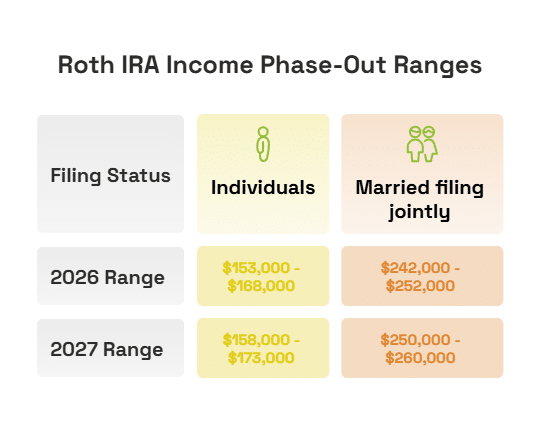
While the Roth IRA contribution limit remains unchanged, the income thresholds governing eligibility have increased. For individuals, the Roth IRA contribution phase-out range rises to between $158,000 and $173,000 in 2027.
In 2026, the range was between $153,000 and $168,000. For married couples filing jointly, the phase-out range increases to between $250,000 and $260,000, compared with $242,000 to $252,000 in 2026.
People with income above the relevant range cannot make direct Roth IRA contributions.
How Much Can Workers Save in 2027?
The new limits create several potential maximums for workers using employer-sponsored plans.
| Saver | 2026 limit | 2027 limit |
|---|---|---|
| Standard 401(k) contribution | $24,500 | $25,500 |
| Catch-up contribution, age 50+ | $8,000 | $8,500 |
| Total for eligible workers aged 50+ | $32,500 | $34,000 |
| Special catch-up, ages 60-63 | $11,250 | $11,750 |
| Total for eligible workers aged 60-63 | $35,750 | $37,250 |
| IRA contribution | $7,500 | $7,500 |
| Traditional IRA catch-up | $1,100 | $1,100 |
The higher 401(k) limits mainly benefit workers who have enough disposable income to save substantial amounts each year.
Most Workers Do Not Max Out Their 401(k)
The increase in the contribution ceiling does not mean most Americans will be able to use the full amount. According to Vanguard’s How America Saves 2026 report, only 14% of participants with Vanguard 401(k) accounts contributed the maximum amount in the previous year.
Those who reached the limit tended to be older and have higher incomes. Financial advisers generally recommend that workers save what they can and, where available, contribute enough to receive their employer’s full 401(k) match.
Employer matching can add to retirement savings without requiring the employee to contribute the entire annual limit.
Why 401(k) Contributions Can Reduce Taxable Income
Traditional 401(k) contributions are generally taken from income before federal income tax is calculated. This can reduce a worker’s taxable income for the year in which the contribution is made.
Taxes are generally paid when money is withdrawn from the account in retirement. Roth accounts work differently. Contributions are made with after-tax income, while qualified withdrawals can generally be made without federal income tax.
The different tax treatment means the choice between traditional and Roth savings can depend on a worker’s income, tax situation and expectations about future taxes.
The new IRS limits give Americans more room to save through employer-sponsored retirement plans in 2027, even though the IRA contribution ceiling remains at $7,500.