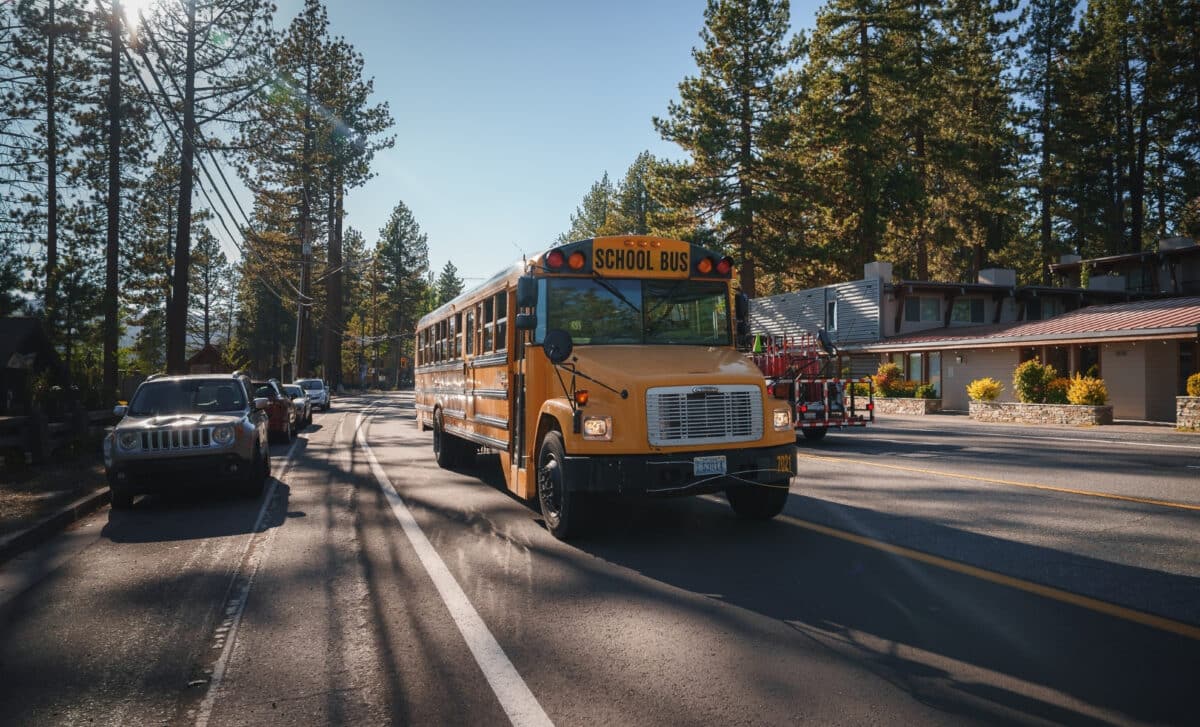
Previously, drivers were mainly required to stop for these buses on two-lane roads. The new law extends the requirement to additional road layouts where traffic moves in both directions and where no physical separation exists between lanes.
The updated law applies to two- and three-lane roads, roads with multiple lanes and a center turn lane, and four-lane or wider roads without a raised barrier or an unpaved median separating traffic directions.
New Rules Expand Where Drivers Must Stop for Buses
The law requires vehicles in both directions to stop on covered roads when a school or church bus has activated its warning lights and started extending its stop arm. Drivers traveling on the same side of the road as the bus must stop even when a road has multiple lanes.
The only exception applies to drivers traveling in the opposite direction on a four-lane or wider road when traffic is divided by a raised physical barrier or an unpaved median. In those cases, opposite-direction traffic is not required to stop, while vehicles near the bus must still wait.
The expanded requirements replace the previous limitation that mostly focused on two-lane roads. The measure changes the situations where drivers are legally required to remain stopped while children enter or leave buses.

Kentucky Introduces Higher Penalties and Bus Cameras
Drivers who violate the law face a $300 fine for a first offense. A second offense and any later offenses within three years carry a $500 penalty.
The law also allows school district officials to install cameras on the outside of buses to record drivers who pass stopped buses illegally. If the driver cannot be identified at the time of the violation, responsibility can fall on the registered owner or lessee of the vehicle.
According to The Sun, Kentucky’s measure follows similar stop arm laws adopted in other states, with penalties varying depending on local regulations.
Missouri introduced a statewide stop arm law with $500 fines for each violation, possible license suspension, and other penalties. Minnesota Senate File 3623 changed the timing requirement by requiring drivers to stop as soon as school bus red lights begin flashing rather than waiting until the stop arm is fully extended.
Other States Adopt Similar Stop Arm Measures
State governments and local authorities across the United States have introduced stop arm laws requiring drivers to stop for school buses with flashing lights and extended stop arms. Many of these measures include fines of several hundred dollars, with some increasing penalties for repeat violations.
New Haven, Connecticut, recently introduced a local version of the rule with a 30-day grace period before drivers face fines. Rochester, New York, adopted a system with increasing penalties for repeated violations. Other states have also passed similar measures, including one law that can impose fines of up to $1,500 depending on the circumstances.
Supporters of these laws say they are intended to protect children traveling to and from school. Republican State Representative Keith Allen, who authored Minnesota’s bill, told WCCO that the measure was “a straightforward fix to a serious safety issue” and said students should not be put at risk because of gaps in existing rules.