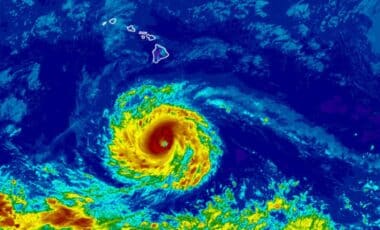
The storm is located more than 1,900 kilometres west-southwest of the southern tip of Mexico’s Baja California peninsula and, according to the National Hurricane Center, poses no threat to land at this stage.
The development of Douglas marks the latest named system of the eastern Pacific hurricane season. Although it has reached tropical storm strength, official forecasts indicate that its evolution should remain over open waters, with no cyclone impacts expected for coastal communities or Hawaiʻi.
According to the National Hurricane Center (NHC), Douglas was upgraded from Tropical Depression Four-E after satellite observations and scatterometer data confirmed a better-defined circulation and sustained winds consistent with tropical storm intensity. Forecast updates continue to track the system as it moves across the eastern Pacific.
Douglas Expected to Strengthen Briefly before Weakening
According to the NHC, Tropical Storm Douglas was centred near latitude 15.7 degrees north and longitude 127.0 degrees west on Wednesday. The system was moving north at around 7 mph (11 km/h), with maximum sustained winds of 40 mph (65 km/h) and stronger gusts.
The National Hurricane Center said tropical-storm-force winds extended up to 90 miles (150 kilometres) from the centre. Forecasters also indicated that a gradual turn towards the northwest is expected later this week.
According to the forecast discussion, Douglas is currently embedded in a moist environment with low wind shear and warm sea surface temperatures. Those conditions may allow some additional strengthening through Wednesday night.
After that period, the outlook changes. The same forecast states that the storm is expected to encounter increasing mid-level dry air, cooler waters and decreasing upper-level divergence from Thursday onwards. Those environmental factors are forecast to lead to gradual weakening, with Douglas expected to become a post-tropical cyclone on Friday before eventually dissipating into an open trough later in the forecast period.
Forecast Track Keeps the Storm Away from Populated Areas
The storm’s projected path continues to keep it over open waters. According to the Associated Press, Douglas was located roughly 1,220 miles west-southwest of the southern tip of Baja California when it was named, and forecasters said it posed no threat to land.
According to reports, the system does not appear to present a cyclone threat to Hawaiʻi. Forecast positions released by the National Hurricane Center show Douglas continuing on a generally northward track before gradually turning northwest and later west-northwest as it weakens.
The official forecast also shows a steady decline in wind speeds after the initial strengthening phase. Maximum sustained winds are expected to decrease as the storm loses organisation, with post-tropical status forecast within 48 hours of the advisory issued on Wednesday.
Throughout the forecast period, the National Hurricane Center continues to indicate that Douglas will remain over the eastern Pacific Ocean without affecting land areas. The latest advisories maintain that outlook while monitoring the storm’s gradual weakening and eventual dissipation over open water.