
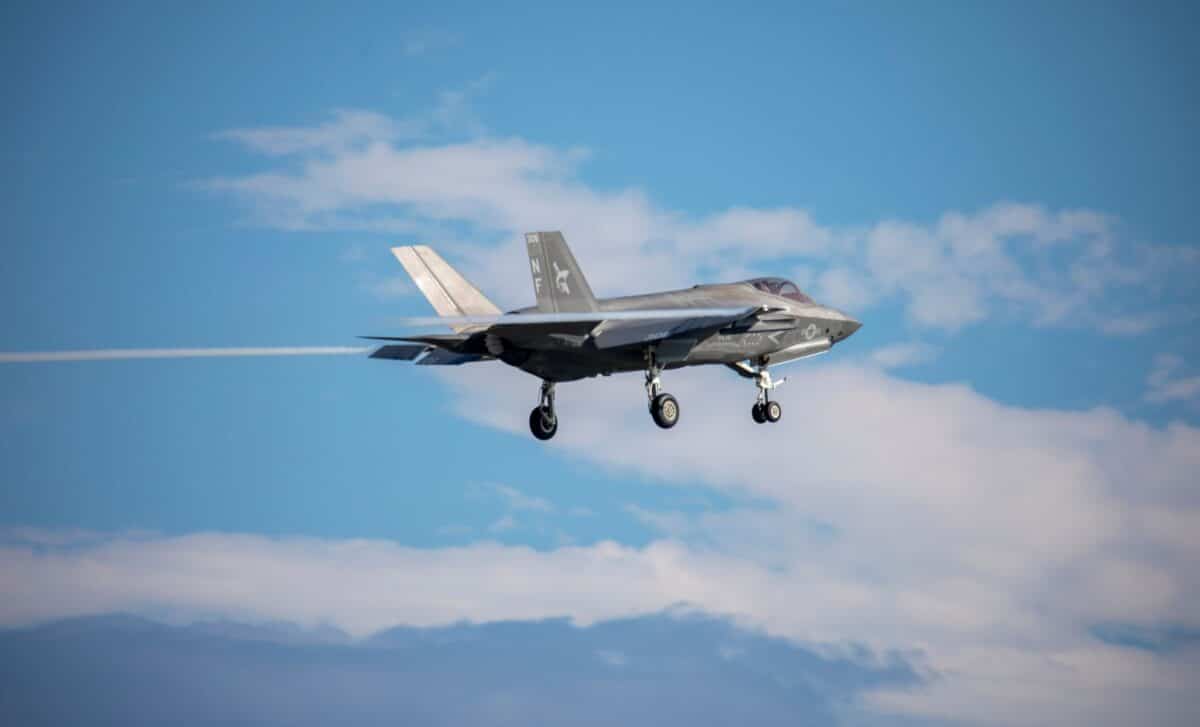
Billions are directed toward the Air Force’s F-47, while the Navy’s F/A-XX receives comparatively limited funding. This divergence could reignite long-standing tensions between the Pentagon, the White House, and Congress over priorities in future air combat capabilities.
The Trump administration’s $1.5 trillion defense request places clear emphasis on accelerating the Air Force’s sixth-generation fighter program. According to budget documents reported by Defense One, roughly $5 billion has been allocated to the F-47, all drawn from baseline discretionary funding.
By contrast, the Navy’s F/A-XX program is set to receive just $140 million in the same request, with nearly half of that amount tied to a proposed reconciliation bill. The gap highlights differing strategic priorities between the services, even as both programs are intended to define the next era of U.S. air superiority.
Air Force’s F-47 Program Advances With Major Investment
The F-47 remains a central focus of the administration’s modernization plans, with officials framing it as critical to maintaining global air dominance. According to Defense One, the budget underscores a goal of achieving a first flight by 2028, signaling an accelerated development timeline.
This follows significant prior investment. The aircraft received $2.5 billion in the 2026 budget request, along with an additional $900 million through reconciliation funding, bringing last year’s total to $3.5 billion. The jet, built by Boeing, is positioned as a cornerstone of future air combat strategy.
The broader budget also reinforces continued procurement of existing platforms. According to an Office of Management and Budget spokesperson, the administration is requesting 85 F-35 fighters across the Air Force, Navy, and Marine Corps. Of these, 38 would go to the Air Force, 37 to the Navy, and 10 to the Marine Corps, with funding split between discretionary spending and reconciliation measures. Taken together, these allocations suggest a dual-track approach: sustaining current fifth-generation capabilities while rapidly advancing the next generation through the F-47.
© Shutterstock
Navy’s F/A-XX Program Faces Uncertainty Despite Earlier Support
The Navy’s F/A-XX program, intended to replace the F/A-18E/F Super Hornet, has seen fluctuating levels of support. While the latest budget request proposes limited funding, Congress previously moved in the opposite direction.
According to the same source, lawmakers increased F/A-XX funding more than tenfold earlier this year, raising it from $74 million to $897 million. When combined with $750 million from a reconciliation bill, total enacted funding reached nearly $1.7 billion.
That increase came with conditions. Legislators requested detailed information on the program’s acquisition strategy, spending plans, and development timeline, along with an explanation for why earlier allocated funds had not been fully spent.
Meanwhile, the program itself is approaching a key milestone. According to Reuters, the Navy is expected to select a contractor for the engineering and manufacturing development phase, with Boeing and Northrop Grumman among the leading contenders. The aircraft is expected to feature advanced stealth, extended range, and integration with uncrewed systems, with service entry projected in the 2030s.
For now, the disparity in the 2027 request raises questions about how the Navy’s fighter program will progress, especially as congressional backing has, at times, diverged sharply from administration priorities.