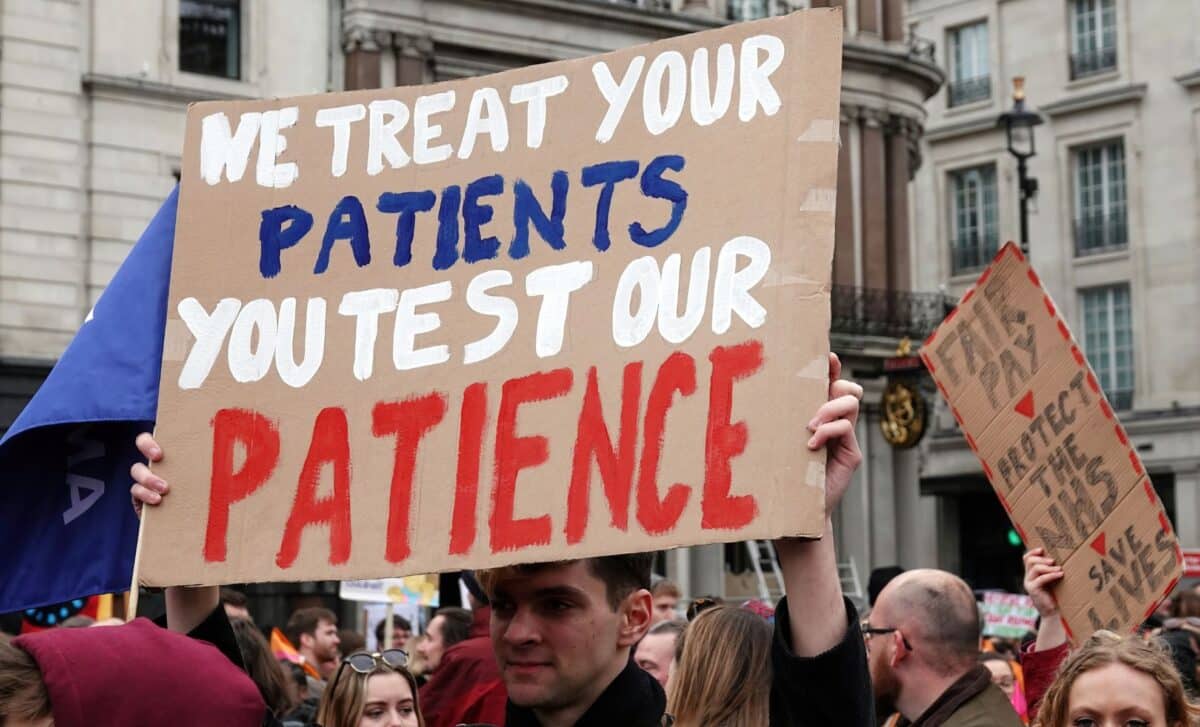
Resident doctors across England have voted in favour of extending strike action for another six months, maintaining pressure on the government in a dispute now stretching into its fourth year. With 93.4% of voters supporting continued industrial action, the British Medical Association (BMA) has secured a fresh mandate to strike, though no new dates have yet been announced.
The long-running disagreement centres on pay restoration and access to training posts, with doctors arguing that the current system undermines career progression and morale. The government, while open to dialogue, insists it has already gone as far as possible on financial terms, pointing to nearly 30% pay increases in the past three years.
Pay Erosion and Training Bottlenecks Driving Discontent
The BMA says resident doctors (formerly known as junior doctors) have faced real-terms pay erosion since 2008. While salaries have increased by 28.9% since 2023, including a 5.4% uplift last year, the union maintains this still leaves earnings around 20% lower when adjusted for inflation. Doctors are demanding a further 26% rise over the coming years to fully restore lost earnings.
The issue, however, is not limited to pay. Access to specialist training posts remains a critical sticking point. More than 30,000 applicants competed for just 10,000 specialty training positions in 2025, highlighting a bottleneck that risks stalling medical careers. The BMA argues that thousands more posts are needed to meet demand.
Health Secretary Wes Streeting has said the government has already increased available training posts from 1,000 to 4,000. Fast-track legislation has also been introduced to give priority to UK-trained doctors. Yet union leaders say these moves fall short of what is needed to resolve the issue.
Dr Jack Fletcher, chair of the BMA’s resident doctors committee, said: “And without thousands more training posts, the bottlenecks in medical training are going to continue to rob brilliant young doctors of their careers. Doctors have today clearly said that is not acceptable.”
Mandate Renewed but Turnout Falls
While the latest ballot shows overwhelming support for further strike action, voter turnout has declined. Just over half of eligible doctors took part in the vote, with 52.5% turnout compared to 55.3% in the previous ballot, as reported by Sky News. This means only around 33% of England’s 81,000 resident doctors actively voted for strike continuation.
Government officials have pointed to this reduced turnout as a sign of weakening momentum. A spokesperson for the Department of Health and Social Care said the government remains committed to dialogue and added, “We hope that these talks result in an agreement that works for everyone, so that there is not any more strike action by resident doctors in 2026.”
The strikes have already had a considerable impact on NHS operations, each five-day walkout has cost the NHS an estimated £250 million and caused significant disruption to services. Matthew Taylor, interim chief executive of the NHS Confederation, urged caution. “Health leaders need to see the government and BMA resume talks – through mediation if needed – to find a long-term solution to this dispute.” he said.
As negotiations continue behind closed doors, the tone has reportedly improved. Dr Fletcher acknowledged this shift, stating: “None of this needs to mean more strikes. In recent weeks the government has shown an improved approach in tone compared with the name-calling we saw late last year.”