Around 400,000 UK households could be paying more council tax than necessary because their properties may be placed in a higher band than comparable homes nearby. Checking your council tax band is free, and households that successfully challenge an incorrect band could receive a refund for previous payments, as well as a lower bill in future.
How Council Tax Bands Work
Council tax bands range from A to H, with Band A generally applying to lower-valued properties and Band H to higher-valued homes. The amount charged varies between local authorities and typically rises each year.
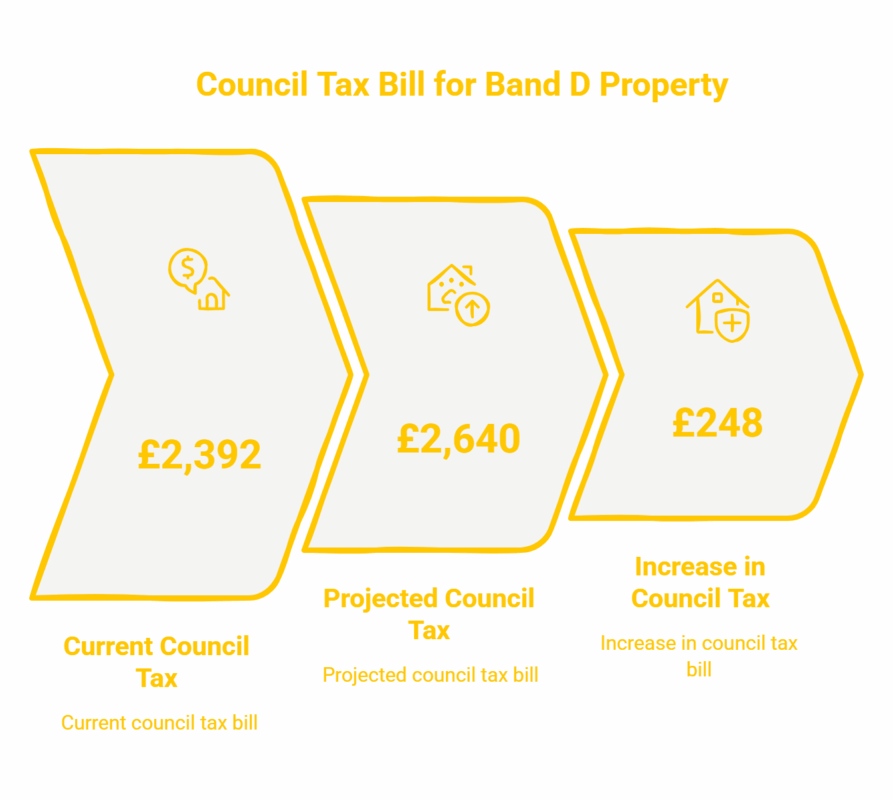
According to figures cited by the Institute for Fiscal Studies, a typical Band D property currently faces a council tax bill of around £2,392. That could reach approximately £2,640 by 2028-29 if projected increases materialise. This would represent an increase of £248.
Check Your Band Against Nearby Properties
One of the first things homeowners can do is compare their council tax band with those of similar properties nearby. The information is available through the Gov.uk council tax service.
The comparison should focus on properties that are broadly similar in size, type and location. A neighbour paying less does not automatically mean your property has been placed in the wrong band.
There can be legitimate reasons why properties in the same area have different bands.
How to Challenge Your Council Tax Band
If the comparison suggests your property may be incorrectly classified, you can make a formal challenge. In England and Wales, challenges are handled by the Valuation Office Agency (VOA). Residents of Scotland should contact the relevant Scottish Assessors Association office.
You will need evidence to support your case. This can include details of comparable properties in the area that have a lower council tax band. The VOA will assess the evidence and determine whether the property’s band should change.
A review can take up to two months, according to the information provided.
Be Careful Before Making a Challenge
Finding that a nearby property has a lower band does not guarantee that your own band will be reduced. There is also a potential downside to challenging your band. If the assessment finds that your property has been placed in a band that is too low, your band could potentially be increased.
Homeowners should therefore gather evidence and check the circumstances carefully before making a formal challenge.
How Much Could a Refund Be Worth?
The amount refunded depends on how long the property was in the incorrect band and the difference between the old and new council tax charges. Some successful challenges have resulted in refunds worth thousands of pounds.
One MoneySavingExpert reader, identified as Kevin, said his property was moved from Band E to Band D following a challenge. He reported receiving a £7,213 refund and said his future payments would be around £50 lower each month.
The case took around 18 months to complete, showing that a successful challenge can take considerably longer than the initial assessment period.
Other Homeowners Have Reclaimed Money
Other examples show that refunds can vary considerably. One homeowner reported receiving around £1,300 after challenging their council tax band. Another said they received £2,256 and saw their future council tax payments reduced.
These examples are individual cases rather than guarantees of how much a successful challenge will return. The refund available to each household depends on its own council tax history and the outcome of the band review.
What to Do Before Applying
Homeowners who believe they are paying too much should first check their council tax band, compare their property with similar nearby homes and gather supporting evidence. Residents in England and Wales can use the VOA’s online service, while Scottish residents should contact their local assessor.
A successful challenge can result in both a lower council tax bill going forward and a repayment for eligible past payments. Anyone considering a challenge should also check the evidence carefully, as a review does not automatically lead to a lower band and could produce a different assessment.