
The proposal is part of a wider review of how disability benefits are structured in England and Wales. The IFS says the current system provides the same payment level to people with different assessed levels of disability, raising questions about whether awards should be more closely linked to individual assessment scores.
IFS Examines a Points-Based Approach to PIP Payments
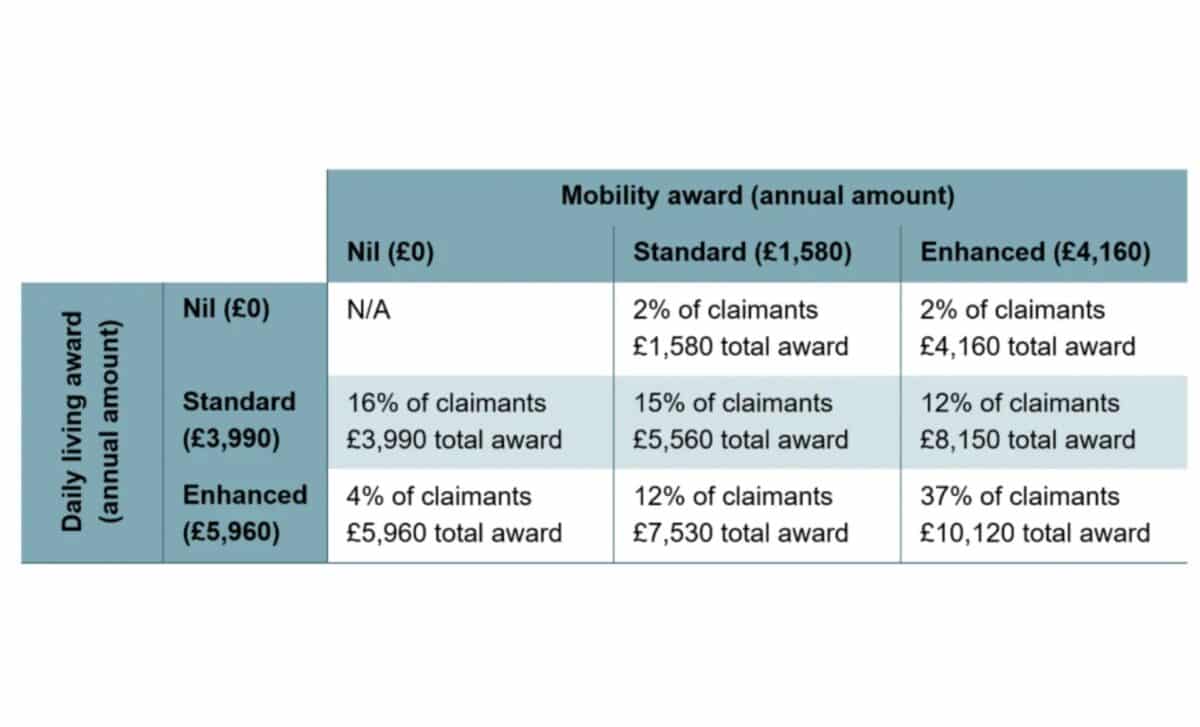
Personal Independence Payment (PIP) is currently awarded through two components: daily living and mobility. Claimants receive either a standard or enhanced award depending on their assessment score, with no further increase for those who score significantly above the threshold.
According to the Institute for Fiscal Studies, 53% of claimants reach the threshold for the highest daily living award, which requires at least 12 points. Among all claimants, 26% receive 16 points or more, while 5% receive at least 31 points. Despite these differences in assessed needs, those claimants receive the same daily living payment.
The IFS said this creates “significant variation” between people receiving enhanced awards. It suggested that a system where payments increase gradually according to the number of points awarded could make support more closely reflect assessed disability levels.
Under the model analysed by the IFS, the first seven points scored on either the daily living or mobility component would not attract payment. The remaining points would determine the size of the award, with the value of each point set so that overall spending on each component remained unchanged before considering any behavioural responses.
The organisation described the system as a “simple illustrative alternative” rather than a final recommendation. The report forms part of wider work examining possible changes to disability benefits ahead of the government’s consideration of reforms.
Report Highlights Differences Among PIP Recipients and Possible Reform Challenges
The IFS report also examined recent changes in disability benefit claims and the wider operation of PIP. It found that the number of working-age people claiming disability benefits increased from 5.5% of 16- to 64-year-olds in August 2019 to 8.2% in August 2025.
According to the IFS, spending on working-age disability benefits rose from £14 billion in real terms in 2019–20 to £25 billion in 2025–26. Official forecasts cited in the report indicate spending could reach £34 billion in 2030–31.
The report noted that PIP claimants often experience greater financial pressures than disabled people who do not receive the benefit. It found that 51% of PIP claimants were classified as being in material deprivation, compared with 33% of disabled people not claiming PIP and 15% of people without disabilities.
The IFS also examined other possible reforms, including changes to eligibility rules and the use of medical diagnoses. It reported that 85% of PIP claimants already report having a medical diagnosis, while 69% report having multiple diagnoses for different conditions.
The organisation said any changes to PIP would involve choices about how support is targeted and how assessments are carried out. The report focuses on possible structures for the benefit system rather than setting out a single preferred approach.
The government’s Timms Review is examining the future design of disability benefits and is due to make recommendations on the system. According to the IFS, the review is considering structural changes while keeping spending on disability benefits in line with or below current forecasts.