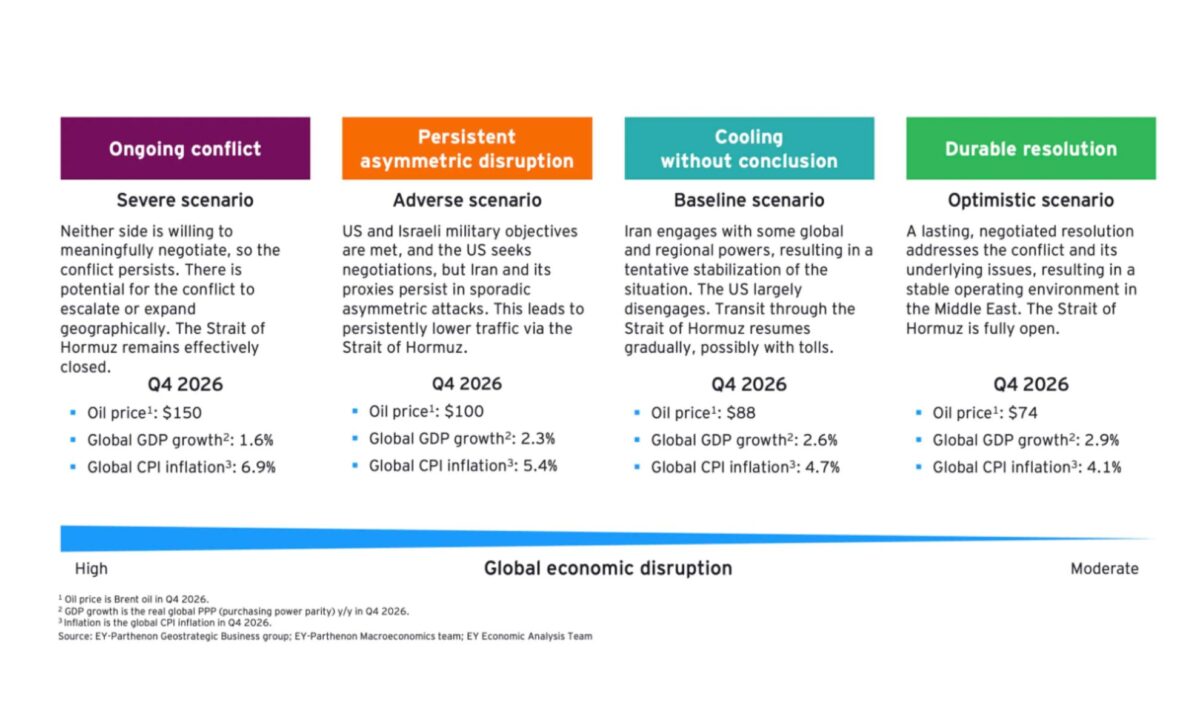
The report presents two possible scenarios. If the strategic waterway reopens by the end of the third quarter of 2026, EY expects the UK economy to remain on a modest growth path. If the closure continues into early or mid-2027, the consultancy warns that weaker growth, rising prices and lower business investment could weigh heavily on the economy.
Prolonged Disruption to Energy Markets Could Trigger Economic Contraction
According to EY’s latest economic outlook, the UK economy would grow by just 0.5% in 2026 before contracting by 0.2% in 2027 if the Strait of Hormuz remains closed into next year. The report links this scenario to continued disruption in global energy markets, as around one-fifth of the world’s oil and gas normally passes through the waterway.
EY says inflation could reach 6.4% by the end of 2026 under this adverse scenario as oil and gas prices rise. The consultancy also expects household spending to remain subdued as consumers face higher prices alongside delayed reductions in interest rates. Consumer spending is forecast to increase by 0.3% in 2026 before improving to 0.9% in 2027.
The report follows the Bank of England’s latest interest rate decision, which left Bank Rate unchanged at 3.75%. According to the Bank of England, policymakers remain prepared to raise rates if the conflict involving Iran continues for many months and leads to a sharp increase in inflation. The Bank also said Consumer Prices Index (CPI) inflation, recorded at 2.6% in June, is expected to peak at around 3.2% later this year before gradually returning towards its 2% target.
Peter Arnold, EY UK chief economist, said the UK economy had shown greater resilience than many expected during 2026, prompting a modest upgrade to the firm’s growth forecast. He added that ongoing disruption to global energy markets would now test that resilience, while an extended closure of the Strait of Hormuz could push the economy into contraction next year.
Base-Case Forecast Remains More Resilient if Shipping Route Reopens
According to EY, its central forecast assumes that the Strait of Hormuz reopens before the end of the third quarter of this year. Under that scenario, UK gross domestic product is expected to expand by 0.9% in 2026, an improvement from the consultancy’s previous forecast of 0.8%, while growth of 1.2% is projected for 2027.
The report also expects interest rates to remain at 3.75% for the rest of 2026 before being reduced twice, in April and July 2027, leaving Bank Rate at 3.25% by the end of next year.
EY has revised its outlook for business investment, now forecasting a decline of 0.7% during 2026 after previously expecting investment to remain broadly unchanged. The consultancy also highlighted continuing pressures affecting the construction sector, including rising project costs, labour shortages and weak productivity growth, which it said could constrain the delivery of major infrastructure projects.
In its assessment, EY said the UK is likely to depend increasingly on sectors such as technology and high-value business services as sustaining broader economic growth becomes more challenging. The report stresses that the path of the economy will depend heavily on developments in global energy markets and the future of the Strait of Hormuz.