The tenth anniversary of the 2016 referendum has renewed scrutiny of Brexit’s economic consequences. According to reporting by The Guardian, economists broadly agree that the UK economy is smaller than it would have been had the country remained in the European Union. The effects have unfolded gradually rather than through the sharp downturn that dominated much of the public debate before the vote.
The picture has been complicated by major global events, including the Covid-19 pandemic, the war in Ukraine and international trade disputes. Even so, several measures of economic performance indicate that Britain has underperformed relative to expectations and comparable advanced economies.
Growth, Investment and Employment Have Faced Persistent Pressures
According to research cited by The Guardian, UK GDP per head is estimated to be between 6% and 8% lower than it would have been without Brexit. The analysis, led by economist Nick Bloom and other researchers, compared Britain’s performance with that of 33 advanced economies and found that a noticeable gap emerged after 2016. The Office for Budget Responsibility has also estimated that the UK is on course to experience a 4% reduction in national income over a 15-year period as a result of Brexit-related changes.
Business investment has been another area of concern. Years of political uncertainty following the referendum led many firms to delay or reduce spending plans. According to The Guardian, investment is estimated to be close to 18% lower than it would have been under a remain scenario, while productivity is estimated to be up to 4% lower.
Economist John Springford of the Centre for European Reform told the newspaper that the investment slowdown began in 2016 and continued until greater certainty emerged over the future trading relationship. He linked weaker investment to lower productivity, arguing that businesses were slower to upgrade equipment and infrastructure.
Employment figures have also been affected. While unemployment initially remained low, research cited by The Guardian suggests that employment is between 3% and 4% lower than it would have been if the UK had remained in the EU.
Trade Patterns Have Changed as Public Opinion Shifts
Trade remains closely tied to Europe despite the UK’s departure from the bloc. According to official UK trade statistics published by the Department for Business and Trade, exports to the EU were worth £385.4 billion in the four quarters to the end of December 2025, while imports from the EU totalled £474.1 billion. The EU remained the UK’s largest trading partner during that period.
The same official figures show that total UK exports reached £937 billion in the 12 months to March 2026, while imports stood at £980.4 billion. Officials note that caution is needed when comparing some trade data across the post-Brexit period because of changes in data collection following the UK’s departure from the EU.
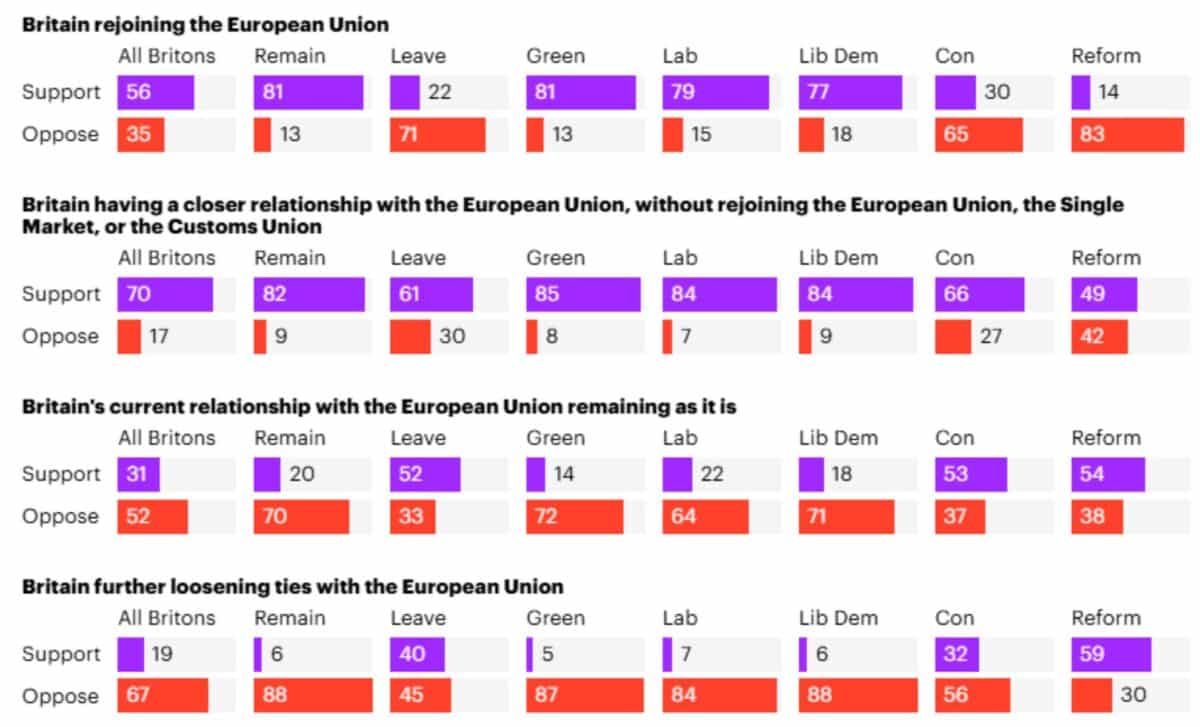
Public attitudes towards Brexit have also evolved. According to YouGov data published in May 2026, 70% of Britons support a closer relationship with the European Union without rejoining the bloc, while 56% support rejoining the EU outright. The polling also found that only 19% support further loosening ties with the EU.
As the referendum reaches its tenth anniversary, the debate has shifted from the immediate consequences of leaving the EU to the longer-term effects on growth, trade and living standards. The evidence cited by economists, official statistics and public opinion surveys suggests that those questions remain central to the UK’s economic and political landscape.