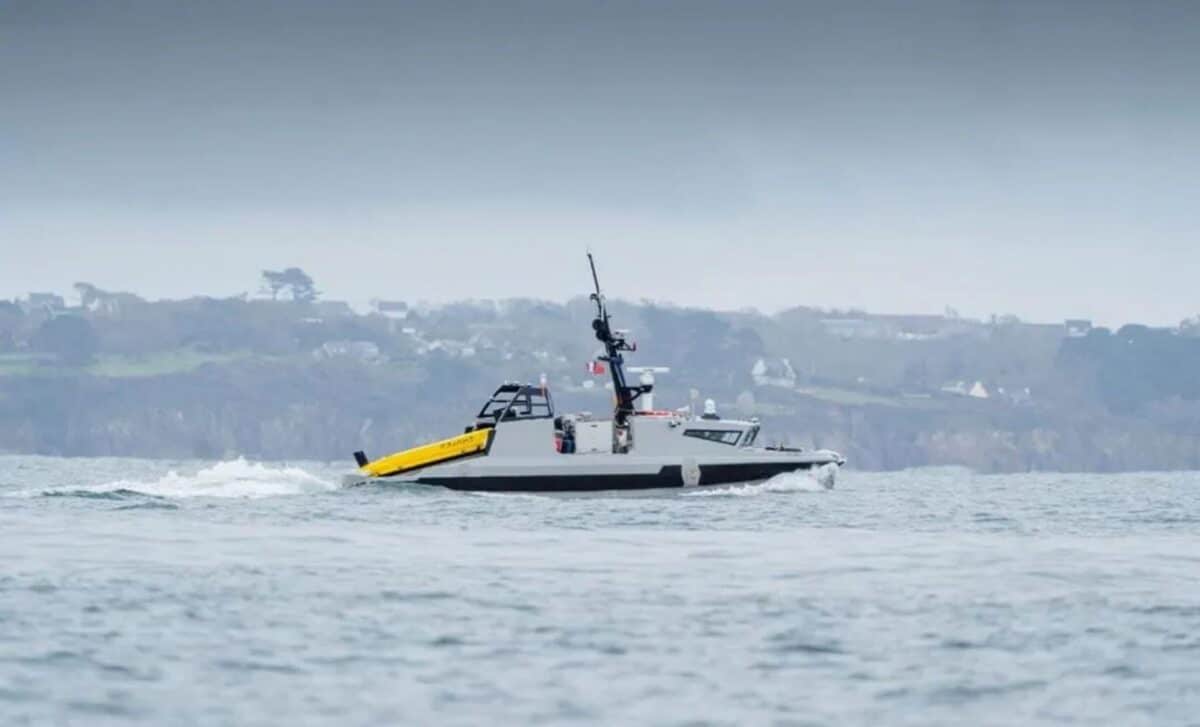
The Royal Navy has brought an uncrewed minehunting system called Adventure into service, marking a significant shift away from crewed vessels towards remotely managed mine clearance. The system was formally delivered on 3 April 2026 in Plymouth, under a joint UK-France programme led by defence technology firm Thales.
Naval mines remain among the most cost-effective means of disrupting maritime movement, threatening commercial shipping lanes, naval operations, and undersea infrastructure. Adventure is designed to address that threat while keeping personnel away from hazardous areas.
A Distributed System, Not a Single Vessel
Adventure is not a standalone drone but rather a central node within a broader mine warfare network. The 12-metre uncrewed surface vessel carries and deploys a range of off-board systems, allowing operators to manage missions remotely from shore or from host ships.
The platform integrates surface drones, underwater vehicles, and remote command centres into a single operational framework. This architecture allows the Navy to conduct the full mine-clearing sequence, search, identification, and neutralisation, without exposing personnel to direct risk.
Adventure follows the earlier Ariadne unit and is among the first four planned deliveries under the programme. Together, these form the initial operational capability of the joint effort, which carries a total value of approximately €430 million (around $500 million), with the United Kingdom contributing roughly £184 million.
The Royal Navy plans to operate Adventure across two primary theatres. HMS Stirling Castle will support missions in home waters, while RFA Cardigan Bay will serve as a forward base in the Gulf region, reflecting the system’s intended flexibility across different strategic environments.
Sonar, Artificial Intelligence, and Remote Neutralisation
The system’s detection capability rests on Thales’s Towed Synthetic Aperture Multiview sonar, which captures detailed seabed imagery from multiple angles in a single sweep. This approach reduces analytical uncertainty and is paired with AI-based recognition tools that process sonar returns quickly, shortening the time operators require to assess potential threats.
For closer inspection, Adventure can deploy underwater vehicles including the SeaCat, supporting both wide-area scanning and targeted examination of suspected mines.
Neutralisation is handled by Saab’s Double Eagle remotely operated vehicle, which can carry multiple explosive charges and engage several mines during a single deployment. The vehicle is rated to operate at depths of up to 300 metres and is designed for precise charge placement to ensure reliable detonation. This reduces the number of repeated deployment cycles required and improves overall clearance tempo.
The system is capable of functioning in moderate sea conditions, making it suitable for operations near ports and congested shipping routes.
Adventure also aligns with NATO requirements for securing maritime approaches, according to information provided alongside the programme announcement. Rather than investing in single-purpose vessels, the Royal Navy is building modular, remotely managed capabilities intended to adapt across mission types and operational environments, a philosophy that reflects a wider transformation underway across Western naval forces.