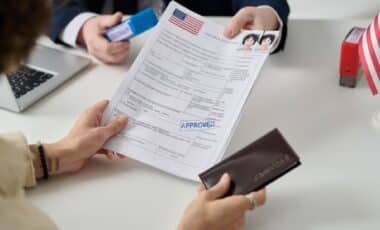

The U.S. Supreme Court recently made a significant ruling, deciding not to hear a challenge against a federal rule that allows certain spouses of H-1B visa holders to work in the United States. This decision upholds a previous appellate court ruling, which confirmed the legality of the rule and marks the end of nearly a decade of legal battles.
As a result, H-1B families, many of whom are dealing with long green card backlogs, now have a clearer path forward regarding employment authorization.
Nearly a Decade of Legal Challenges for H-4 Visa Work Authorization
The legal dispute over the “Employment Authorization for Certain H-4 Dependent Spouses” rule dates back to 2015, when the Department of Homeland Security (DHS) introduced the regulation. The rule grants H-4 visa holders—typically spouses of skilled H-1B workers—permission to work while they await permanent residency.
At the time of its introduction, the DHS estimated that 180,000 people would benefit from the rule in its first year, with about 55,000 individuals benefiting each subsequent year.
However, the rule was immediately met with resistance, particularly from Save Jobs USA, a group representing U.S. technology workers. They argued that the DHS overstepped its legal authority by extending work authorization to H-4 visa holders, despite Congress not specifically granting such powers.
The petition filed in August 2024 aimed to challenge whether the DHS could
Grant work authorization for classes of nonimmigrants for whom Congress has refused to grant work authorization.
After years of litigation, the D.C. Circuit Court of Appeals rejected Save Jobs USA’s arguments, stating that the DHS had the authority to allow work in certain cases. The Supreme Court’s refusal to review the case effectively ends this long-standing legal battle and leaves the D.C. Circuit’s decision intact. The justices did not provide any explanation for their decision, which is typical in cases like these.
Economic Relief for Immigrant Families and U.S. Employers
The Supreme Court’s decision provides stability for immigrant families, especially those affected by lengthy green-card backlogs. Since the rule’s inception, over 258,000 H-4 visa holders have received work authorization.

These individuals, many of whom are highly educated professionals, are crucial to maintaining the financial stability of their households and contributing to the U.S. economy.
The ability for H-4 visa holders to work is particularly significant for the tech sector, where skilled labor shortages are common. Austin Fragomen, founding partner of a prominent immigration law firm, highlighted that restricting work rights for spouses of H-1B workers could drive skilled families to competing economies.
The last thing employers want is a new policy that makes it more challenging to hire or retain talent – he remarked.
This reflects the wider concern that curtailing such rights could destabilize the U.S. economy, pushing highly skilled workers to seek opportunities in countries with more favorable immigration policies.
From a legal perspective, Cyrus D. Mehta, a New York-based immigration lawyer, emphasized that despite recent changes in how courts interpret agency decisions, the statutory provisions supporting this rule are clear.
Despite the evisceration of Chevron deference, courts need not rely on an agency’s interpretation of an INA provision in order to provide noncitizens with work authorization… because these statutory provisions are not ambiguous in the first instance – Mehta stated.
This observation reaffirms the legal foundation of the rule, even in the face of shifting legal doctrines.
Policy Implications and Continuing Debate
This ruling arrives amid a broader debate over H-1B and employment-based immigration. The H-1B program, which allows U.S. companies to hire foreign workers for specialized roles, has long been a critical component of the American workforce. The Biden administration has defended this program, emphasizing its importance for U.S. competitiveness in technology and research sectors.
However, former President Donald Trump proposed a $100,000 fee for new H-1B applications, signaling a potential shift in policy should he return to office.
Jennifer Minear, President of the American Immigration Lawyers Association (AILA), stressed that delays in work authorization have put many H-4 visa holders in financial limbo.
The delays that H-4 and L-2 nonimmigrants are facing needlessly place families in financial limbo. DHS has the legal tools and authority to grant work authorization to impacted individuals whose financial security is hanging in the balance – Minear stated.
Similarly, Jesse Bless, Director of Federal Litigation at AILA, noted that the process to attain work authorization should not expose families to unnecessary financial instability.
The process to attain work authorization should not put families at risk of immense loss of income and instability. There are reasonable and immediate steps that DHS can take to make certain that visa holders meet requirements without imposing needless suffering – Bless added.