A fierce winter storm swept into the Northeastern United States on Sunday, prompting blizzard warnings from Maryland to Massachusetts and bringing large parts of the region to a standstill. Snow began falling in New Jersey and New York as officials urged residents to stay off the roads amid deteriorating conditions.
The system, described by meteorologists as a major winter event, forced widespread travel bans, school closures, and the cancellation of more than 3,500 flights nationwide. Authorities across several states declared emergencies as heavy snow and strong winds threatened to create whiteout conditions and prolonged power outages.
States of Emergency and Widespread Shutdowns
Blizzard warnings were issued for New York City and Long Island, Boston, and coastal communities in Delaware, Maryland, New Jersey, Connecticut, Rhode Island, and Massachusetts, according to the National Weather Service. Forecasts called for 1 to 2 feet (30 to 60 centimeters) of snow in many areas, with visibility expected to drop to a quarter-mile (400 meters) or less.
New York City Mayor Zohran Mamdani announced a ban on non-emergency travel from 9 p.m. Sunday through noon Monday. Emergency alerts sent to residents’ phones warned them to remain off the roads due to dangerous blizzard conditions. Travel restrictions were also planned in parts of New Jersey, Pennsylvania, and Rhode Island.
States of emergency were declared in New York City and other parts of New York state, as well as in New Jersey, Delaware, Rhode Island, Connecticut, and Massachusetts, as officials mobilized response efforts. Broadway performances were canceled Sunday evening, and DoorDash suspended overnight deliveries in New York City.
Air travel was heavily affected. According to the flight tracking website FlightAware, more than 3,500 flights were canceled across the United States as of Sunday afternoon, along with thousands of delays. Airports in New York City and Boston reported widespread cancellations as the storm intensified.
Mayor Mamdani also canceled in-person and virtual classes for city schools on Monday, describing it as the “first old-school snow day since 2019.” Outreach workers were dispatched to encourage homeless residents to seek shelter in warming centers as conditions worsened.
Heavy Snowfall, Strong Winds, and Bomb Cyclone Conditions
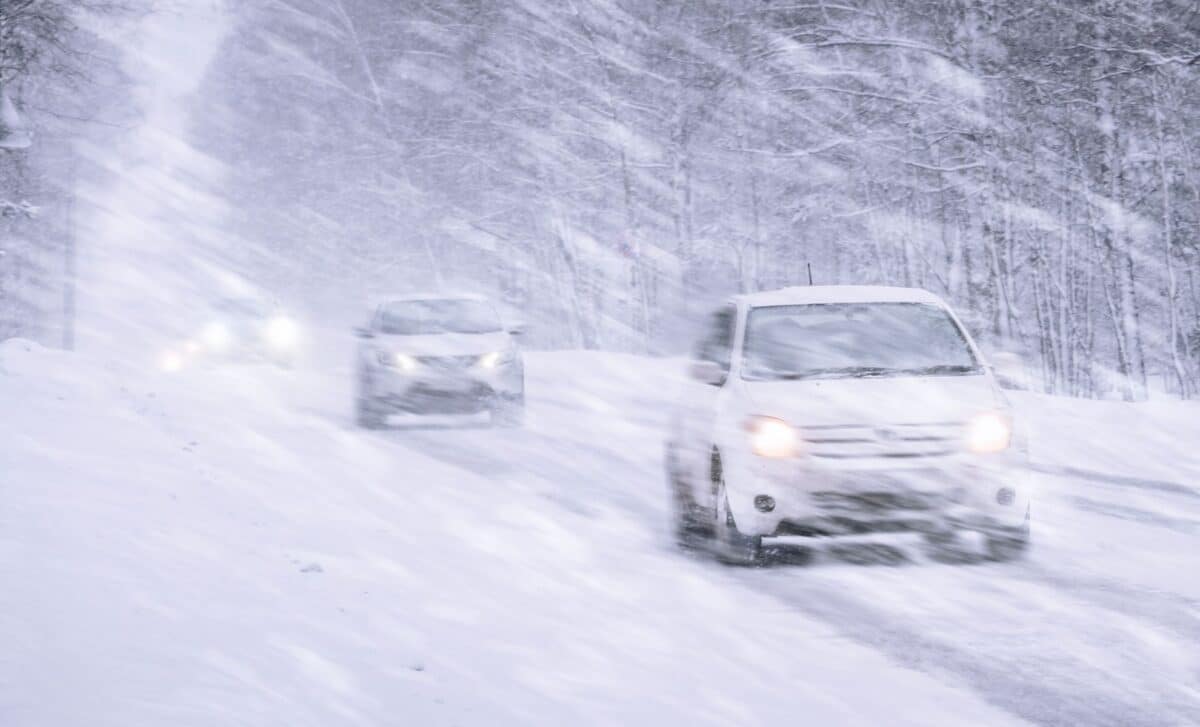
The National Weather Service said the heaviest snowfall was expected overnight Sunday into Monday, with accumulation rates reaching as much as 2 inches (5 centimeters) per hour in some areas before tapering off Monday afternoon. Meteorologists warned that strong wind gusts could combine with heavy, wet snow to create whiteout conditions.
Bryce Williams, a meteorologist with the National Weather Service’s Boston office, said that the combination of extreme snowfall and wind was the primary concern. “Winds like that, combined with heavy, wet snow, are a recipe for damaged trees and prolonged power outages,” he said, according to the Associated Press.
Forecasters also indicated the storm could meet the definition of a bomb cyclone. Frank Pereira, a meteorologist with the weather service, explained that such a designation applies when a storm’s pressure drops at least 24 millibars within 24 hours. “We’re expecting it to drop by that magnitude at least over the course of the next 24 hours,” Pereira said, according to the Associated Press.
Preparations were underway across the region. On Long Island, John Berlingieri, head of Berrington Snow Management, said his company was preparing to clear snow from millions of square feet of asphalt surrounding shopping malls and industrial parks. He anticipated extended operations, with crews working in shifts around the clock as the storm continued to move northward.