Hurricane Priscilla has intensified into a Category 2 storm off Mexico’s Pacific coastline, bringing strong winds, heavy rainfall and turbulent surf to coastal regions. According to the National Hurricane Center (NHC) in Miami, the storm is now tracking northwest towards the southern tip of Baja California, prompting authorities to issue tropical storm watches and take precautionary measures.
Situated approximately 245 miles south of Cabo San Lucas, Priscilla has sustained winds of 100 mph and is advancing at 10 mph. The storm’s outer bands have already begun to impact communities in Los Cabos and La Paz, where local officials have cancelled classes and opened shelters in anticipation of deteriorating conditions.
Storm Systems Put Pressure on Western Mexico
Priscilla’s approach has intensified concerns across Baja California Sur and neighbouring states, particularly with the possibility of flash flooding in Michoacán and Colima. The NHC has warned that up to 10 centimetres of rainfall could affect parts of southwestern Mexico through Wednesday, while large ocean swells continue to pose life-threatening surf and rip current risks along the Pacific coastline.
The government of Baja California Sur responded on Monday night by suspending school operations in vulnerable areas and preparing a dozen temporary shelters in Los Cabos for residents in high-risk zones. The measures, though precautionary, reflect growing anxiety over the storm’s potential to escalate into a major hurricane in the coming hours.
According to forecasters, Priscilla is not currently expected to make landfall but its proximity to the coast means tropical storm-force conditions are likely to persist in several regions, particularly between Cabo San Lucas and Cabo San Lázaro, where watches remain in place.
Nearby Tropical Storm Octave Weakens Offshore
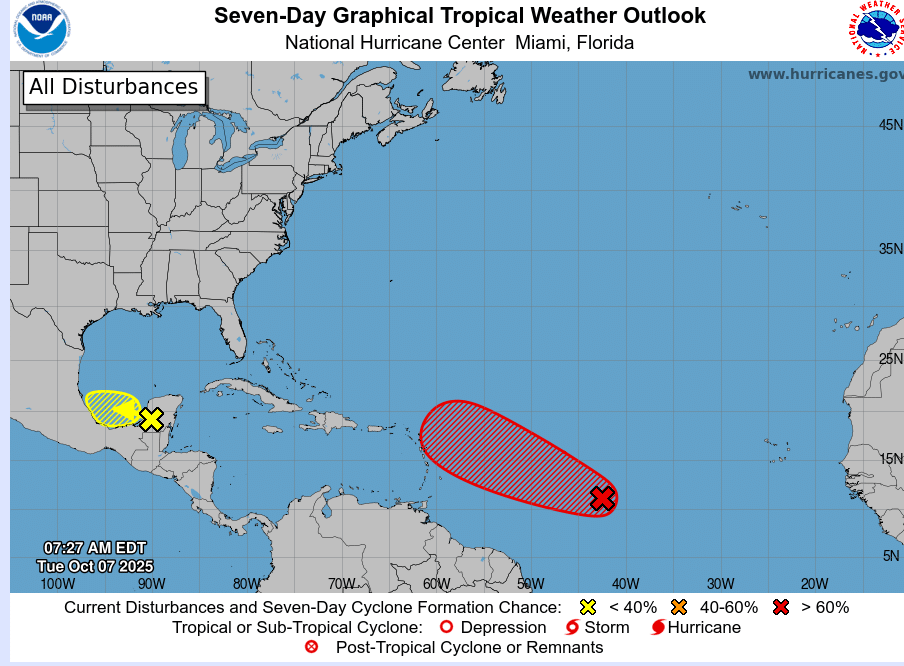
While attention remains fixed on Priscilla, meteorologists are also monitoring Tropical Storm Octave, located approximately 840 miles southwest of the southern tip of Baja California. Although still active, Octave is rapidly weakening and poses no immediate threat to land. With sustained winds of 50 mph, the storm is drifting east-southeast at 7 mph and is expected to dissipate within a few days, according to the National Hurricane Center.
There are currently no watches or warnings associated with Octave, and forecasters have indicated that the system is unlikely to affect populated areas. Its weakening trajectory stands in contrast to Priscilla, which continues to draw concern due to its close proximity to the Mexican coast and the populated tourist hubs in Los Cabos.