

Artificial intelligence is rapidly reshaping the way companies operate — and according to Australian business leaders, the first jobs to feel the pressure will be junior roles. A new global survey from PwC highlights the growing concern among CEOs about how AI will transform the workforce over the next few years.
CEOs Signal Trouble Ahead for Entry-Level Job Roles
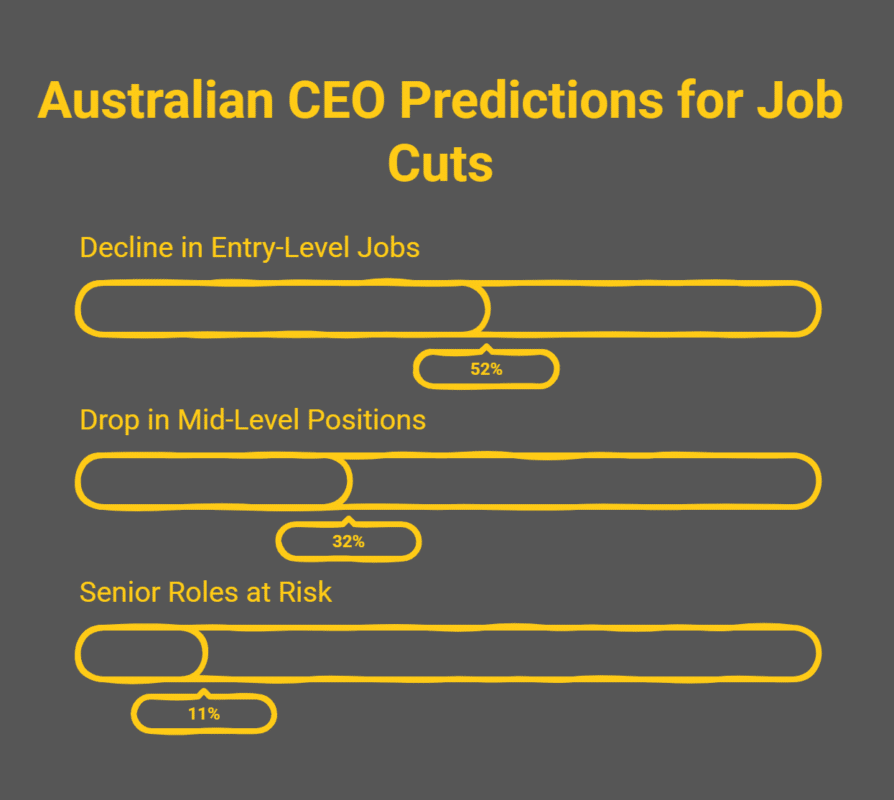
According to the 2026 Global CEO Survey by PwC, over half of Australian business leaders expect to cut junior roles in the next three years as artificial intelligence becomes more entrenched in their operations. Specifically, 52% predicted a decline in entry-level jobs, 32% forecasted a drop in mid-level positions, and even 11% saw senior roles at risk.
That’s not nothing. These aren’t just tech CEOs either — they’re spread across industries, from finance to logistics to media. And it reflects a growing belief that AI won’t just tweak how work is done; it may change who does the work.
But Here’s Where It Gets Murky
The thing is, the data isn’t as clear-cut as it sounds. A separate report by the Australian HR Institute, focusing on the last quarter of 2025, painted a very different picture: 41% of organisations reported an increase in entry-level hiring, with only 19% noting a decrease. Wait, what?
That might seem contradictory, but according to Sarah McCann-Bartlett, the Institute’s CEO, the real story is about transformation, not elimination. AI may take on the repetitive tasks that junior staff usually start with — things like data entry, scheduling, or drafting emails — but that doesn’t necessarily mean the jobs vanish. Instead, they evolve.
And maybe she’s right. Maybe the job of tomorrow’s graduate will be less about admin work and more about managing AI tools, interpreting outputs, and applying judgment where machines fall short. It’s not science fiction — it’s already happening in marketing, HR, customer service, and even law.
Adoption Is Slower Than Expected
Curiously, for all the concern, Australia still lags behind the global average when it comes to AI adoption. Only 12% of Aussie CEOs say their companies are applying AI on a large scale — compared to 19% globally. Even fewer (14%) report seeing actual revenue gains from AI integration, versus 30% worldwide.
Despite this, the majority of companies (around 75%) are training employees to use AI, and 68% have formal guidelines in place. So while the tech may not be everywhere yet, the preparation certainly is.
The Real Question: Replace or Reskill?
The anxiety around AI isn’t just about algorithms — it’s about identity. Entry-level jobs are more than just stepping stones; they’re how people enter industries, build experience, and figure things out. If those vanish, what takes their place?
As CEOs plan for a more automated future, they face a choice: do they use AI to replace human workers, or to augment them? So far, the answer isn’t definitive — but whatever direction they choose, one thing’s clear: the future of work is already knocking.