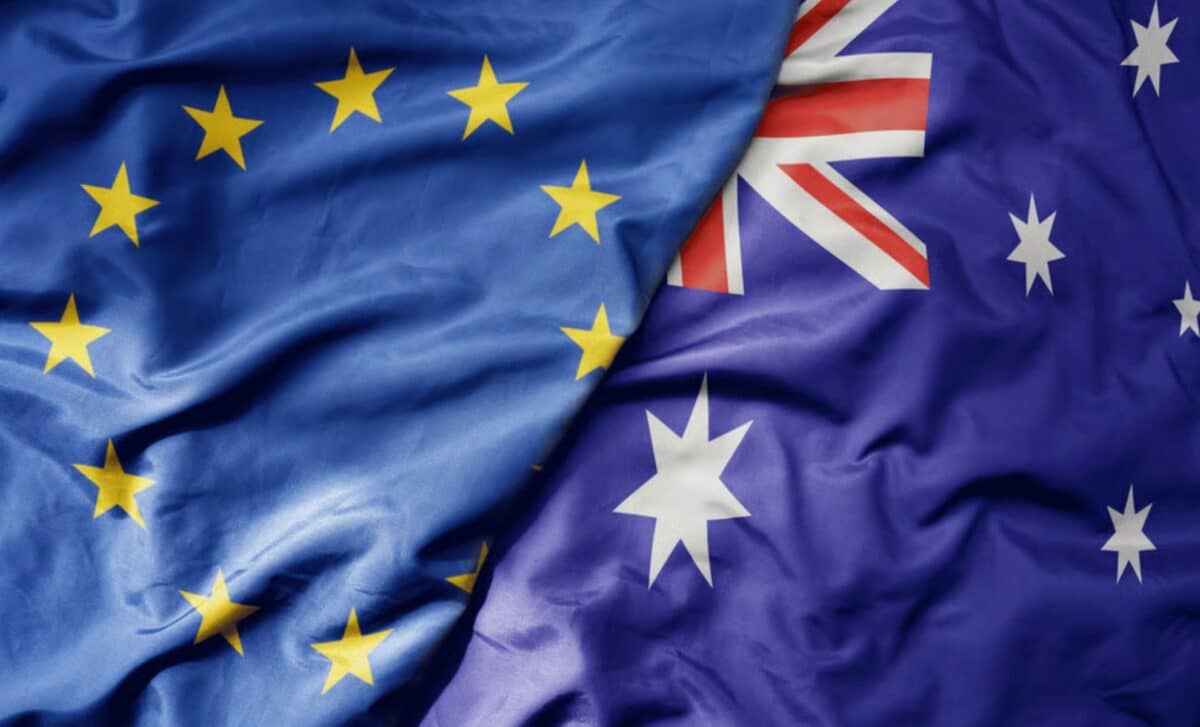
A trade deal can look straightforward on paper. In reality, it quickly turns political when it starts reshaping industries and expectations. The agreement between the European Union and Australia is a clear example—praised as historic, yet already stirring debate across sectors.
A Deal Positioned as a Major Economic Lever
After more than eight years of negotiations, Australia and the European Union have reached a free trade agreement expected to reshape bilateral exchanges. The Australian government estimates the deal could generate around $10 billion annually for the national economy.
The agreement removes tariffs on nearly 97.8% of Australian exports to the European market, which counts around 450 million consumers, reports Yahoo Finance. This broad opening covers sectors ranging from agriculture to industrial goods.
On the import side, European products such as wine, chocolate, pasta and electric vehicles are likely to become more competitive in Australia. It is a concrete illustration of how trade liberalisation translates into everyday market shifts.
Agricultural Access Expands, but Questions Remain
The deal introduces new export quotas for Australian producers. Beef exports to the EU are set to reach 35,000 tonnes per year, while sheep meat will approach 31,000 tonnes annually.
These increases suggest improved access, yet industry representatives remain cautious. Several groups argue that, despite the headline figures, the quotas may still limit real expansion potential. The gap between political messaging and on-the-ground expectations is noticeable here.
Another sensitive point concerns geographical indications. Australia has agreed to recognise 396 protected European product names. In practice, this means local producers will progressively stop using terms such as parmesan or prosecco, unless specific conditions are met. For some businesses, this adjustment is manageable. For others, it creates uncertainty.
Political Opposition Gains Momentum
The agreement has triggered strong political reactions. Senator Matt Canavan described it as “the worst trade deal ever,” reflecting a broader criticism emerging from parts of the opposition.
The National Farmers’ Federation has questioned the real value of the negotiated quotas, arguing they do not provide sufficient access to European markets. Concerns are also growing about potential competition from European imports entering Australia under more favourable conditions.
In the sugar sector, the response has been particularly critical. Industry representatives warn the agreement could lock producers into a framework with limited room for growth. These reactions highlight a recurring tension in trade policy: aggregate gains do not always translate into evenly distributed benefits.
A Strategic Agreement in a Shifting Global Context
Beyond economics, the agreement reflects a changing international environment. With rising trade tensions and tariff measures affecting global supply chains, both Australia and the EU are seeking more stable and predictable partnerships.
European officials have emphasised the importance of rules-based trade and long-term cooperation. The agreement also extends into areas such as defence, cybersecurity and security coordination, illustrating how trade relationships now intersect with broader strategic priorities.
A Debate Likely to Continue Beyond Ratification
The EU-Australia trade deal combines clear economic ambitions with visible political friction. While macroeconomic projections point to growth, sector-level concerns remain unresolved.
As the agreement moves toward parliamentary approval, discussions are expected to intensify. The outcome may be settled on paper, but in practice, its acceptance will depend on how its effects are felt across industries and regions.