
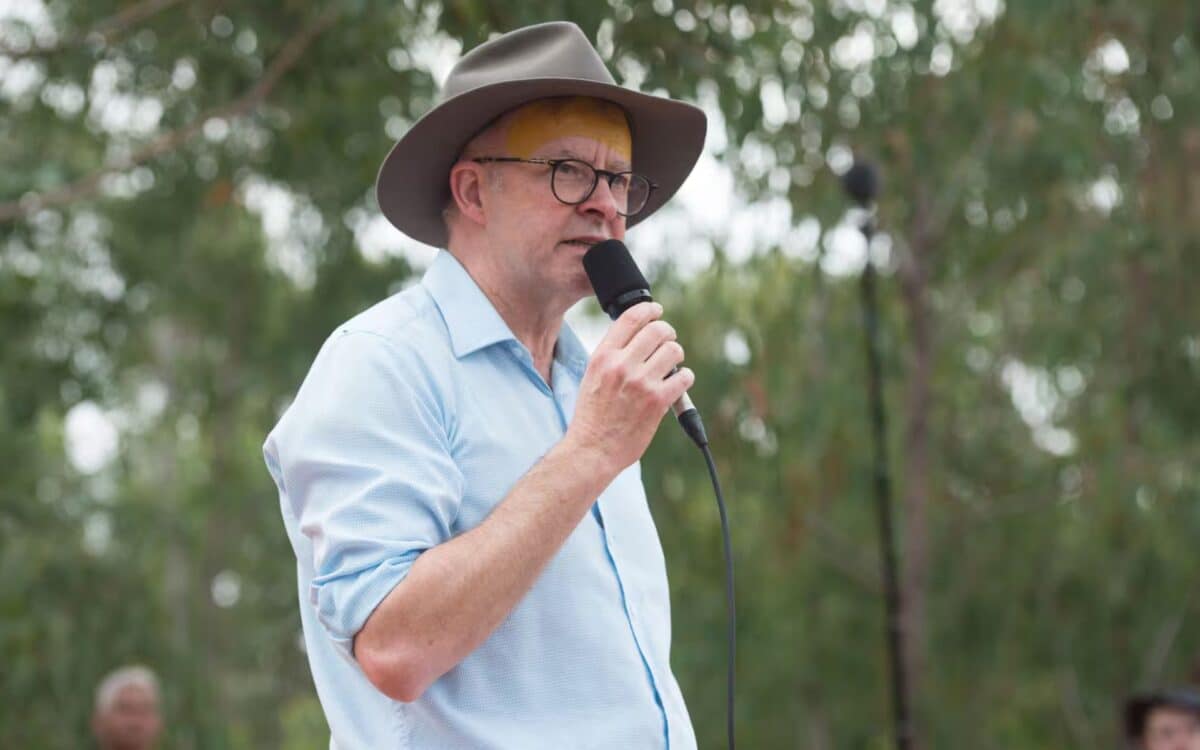
Prime Minister Anthony Albanese has unveiled a new initiative designed to support Indigenous communities in overcoming poverty. During his address at the Garma Festival in north-east Arnhem Land, he highlighted the need to unlock the “true potential of their land” and “the wealth of their land and waters.”
The announcement, though part of a broader economic partnership, does not provide detailed specifics on immediate actions.
According to ABC News, the initiative marks a key step in the government’s ongoing efforts to address Indigenous affairs, focusing on long-term solutions, including skills development, job creation, and business support, but offering limited concrete measures at this stage.
New Economic Partnership for First Nations Communities
The announcement, made at the Garma Festival, reflects a renewed commitment to working with First Nations people. Albanese’s speech highlighted that this new partnership builds on the Closing the Gap Agreement, emphasizing a “new way of doing business” with shared decision-making at its core. He stated,
“Working with Aboriginal and Torres Strait Islander people right around our nation to boost skills and education, create jobs and back businesses.”
In addition, Albanese revealed key funding to back these initiatives. The government has allocated $70 million for First Nations clean energy projects, and $75 million for reforms in Native Title law.
“This is the tone and the standard we want this partnership to set, from the very start — pragmatic action that brings economic development, ownership and equity to communities,” the prime minister said.
These investments, aimed at promoting long-term economic growth, equity, and ownership, are seen as part of a broader strategy to empower Indigenous communities and improve their economic outcomes.
Political Context and the Government’s Renewed Focus on Indigenous Affairs
This announcement follows Anthony Albanese‘s re-election victory in May, where his government secured an increased majority. The focus on economic empowerment builds on the government’s previous agenda, especially after the failed Voice referendum in 2024.
After the referendum, Albanese emphasized that the government would now shift its focus to economic empowerment, an agenda that continues to shape the government’s approach to Indigenous issues.
During his address at the Garma Festival, Albanese acknowledged that the referendum was a setback but reaffirmed his commitment to supporting First Nations people. As part of his plan, he expressed the need for pragmatic, actionable policies that can bring about tangible benefits.
Calls for Renewed Treaty Discussions
Alongside the economic announcements, there were calls for the government to revisit discussions on a treaty with Indigenous Australians. Djawa Yunupingu, a senior leader of the Gumatj clan, urged Prime Minister Albanese to, “work with us, regardless of us losing the referendum. It’s behind us now.”
reflecting a desire to move forward and explore a better path for the future of Indigenous Australians.
Yunupingu also called for the reopening of discussions on a Treaty and Makarrata, emphasizing that these conversations had yet to be properly explored since the Uluru Statement.
“Treaty and Makarrata and the truth-telling is yet to be decided, it is yet to be talked upon or talked amongst like we did for the Uluru Statement,” he said.
Criticism From Opposition Leader
While Anthony Albanese’s announcement was well-received by some, the opposition leader, Sussan Ley, was critical of the government’s approach, particularly its handling of Indigenous affairs following the failed referendum. Ley, who opted not to attend the Garma Festival, claimed that Albanese had “stepped back” from Indigenous issues since the referendum. She questioned the government’s ability to follow through on promises to Indigenous Australians, stating,
“The prime minister traded in the politics of hope and made a number of promises to Indigenous Australians. On many measures these are promises he has not delivered.”
Ley also accused the government of failing to address worsening conditions in critical areas, asking, “So what is his plan?”
She added,
“Since the Voice, Anthony Albanese has stepped back from Indigenous issues, that is not good enough. He led the referendum process, a process which was unsuccessful. So what is his path forward?”