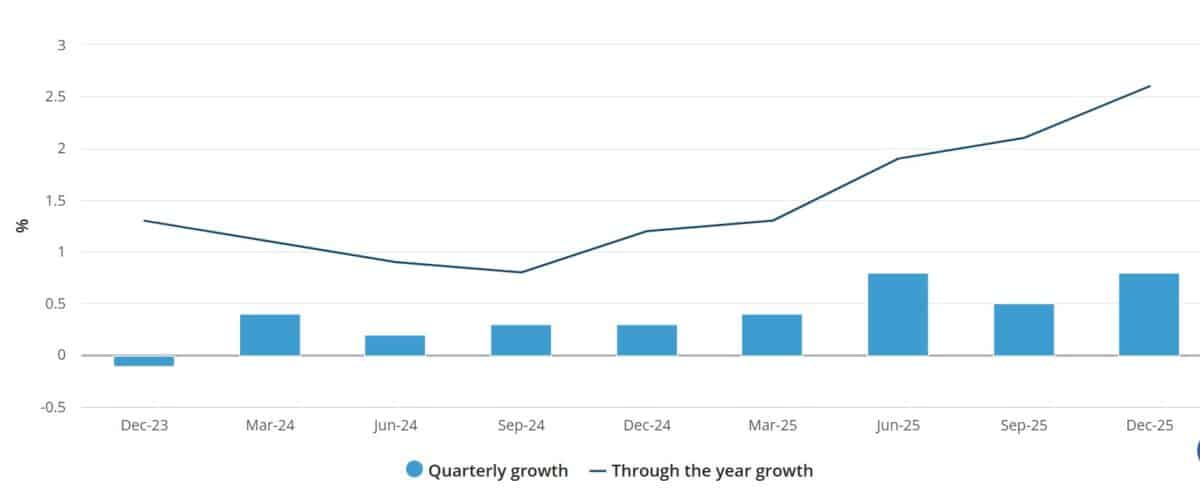
In a welcome boost to the Australian economy, GDP grew by 0.8% in the December quarter of 2025, continuing the trend of economic recovery. Despite ongoing global uncertainties, the economy showed resilience, growing by 2.6% compared to the same period last year. This growth comes as a relief to many, with most sectors contributing to the overall increase, even as public and private demand rose steadily.
What’s Driving the Economic Growth?
There were a number of factors behind the 0.8% growth in GDP, with both public and private demand showing their strength. According to Grace Kim, the head of National Accounts at the Australian Bureau of Statistics (ABS), a broad-based increase in industries played a significant role. Public and private demand each contributed 0.3 percentage points to the overall growth, indicating that both government spending and private sector investment were critical in driving the economy forward.
Household spending increased by 0.3% in the quarter, continuing a positive trend, while discretionary spending saw a boost of 0.4%. This was partly due to big events like Black Friday sales and an increase in attendance at concerts and sporting events. Although essential services spending grew by 0.4%, a slight dip in essential goods spending, such as energy and fuel, kept overall household expenditure from growing more substantially.
Mining and Agriculture Fuel the Surge
While household spending played a part in the economic growth, certain industries experienced significant gains. Mining production, for instance, increased by 2.6%, contributing 0.3 percentage points to GDP growth. This rise in mining activity came after a period of scheduled maintenance, and the sector benefitted from both resuming operations and a rise in global prices for minerals. Agriculture also posted a strong performance, with a 2.5% increase in production, which was largely driven by favorable growing conditions and international demand for Australian meat.
These industries helped push corporate profits up, particularly in mining, where profits rose by 5.7%. This is a welcome result for the sector, which had faced pressure in previous years. Additionally, private investment showed strong results, increasing by 0.7%, marking the fifth consecutive quarter of growth in this area.
Is This Growth Sustainable?
While the numbers look positive, many are questioning whether this level of growth can be maintained. Much of the economic progress relies heavily on traditional sectors like mining and agriculture, with mining profits driving much of the overall increase in corporate earnings. The ongoing strength of these sectors may not last indefinitely, so the real question is whether Australia can diversify its economy to reduce reliance on resource-based industries.
Public investment also continues to climb, with government spending growing by 0.9% during the quarter, thanks to increased infrastructure projects and spending in areas like health, education, and defense.
The Rise in Household Savings
One surprising outcome from the latest data was the rise in household savings. The household saving rate increased to 6.9%, up from 6.1% in the previous quarter, reaching its highest level since September 2022. This is a notable development, especially considering that household disposable income increased by 1.8%, while spending only rose by 1.1%. It’s clear that Australians are more cautious with their money, possibly due to lingering concerns over inflation and global uncertainties.
What’s Next for Australia’s Economy?
Looking ahead, the outlook for the Australian economy is cautiously optimistic. With steady growth in household spending, solid performances in sectors like mining and agriculture, and increasing investment in infrastructure, the economy seems well-positioned. However, maintaining this momentum will depend on both global economic conditions and how successfully Australia can shift toward a more diversified economy.
The government’s continued focus on managing public and private investments, along with efforts to address cost-of-living issues and housing affordability, will play a crucial role in determining whether the growth trajectory remains sustainable in the long term.