

U.S. homebuyers saw improvements in October and early November as mortgage rates declined for several consecutive weeks and lenders expanded access to certain home loans. The changes offered some relief in a housing market where high borrowing costs and home prices continue to limit affordability.
The improvements come as housing activity remains subdued across much of the country. While lower rates can reduce monthly payments, many existing homeowners remain reluctant to sell because replacing their current mortgages would mean substantially higher costs.
Mortgage Rates Decline As Lenders Expand Borrowing Options
According to the Mortgage Bankers Association (MBA), mortgage credit availability increased by 0.4% in October, bringing its Mortgage Credit Availability Index to 107.5. The increase followed two consecutive months of declines and reflected a modest easing in lending standards.
The expansion was concentrated in conventional mortgages, where credit availability rose 0.6%. The jumbo mortgage index increased 0.8%, while the government mortgage index edged up 0.1%. Availability for conforming loans remained unchanged.
Lenders also expanded adjustable-rate mortgage offerings, including cash-out refinancing products for borrowers with lower loan-to-value ratios. These changes provided additional financing options, although they did not necessarily make qualifying for a mortgage easier for every applicant.
Borrowing costs also moved lower. Freddie Mac reported that the average 30-year fixed mortgage rate fell to 7.18% in the week ending November 5, its third consecutive weekly decline. That compared with 7.40% in the weeks ending October 8 and October 15.
Jeff DerGurahian, chief investment officer and head economist at loanDepot, attributed part of the decline to movements in financial markets following the midterm elections. Investors shifted money from stocks into Treasury securities, increasing demand for bonds and pushing Treasury yields lower.
The decline offered some relief, although rates remained above the 6.5% range recorded during the main homebuying season.
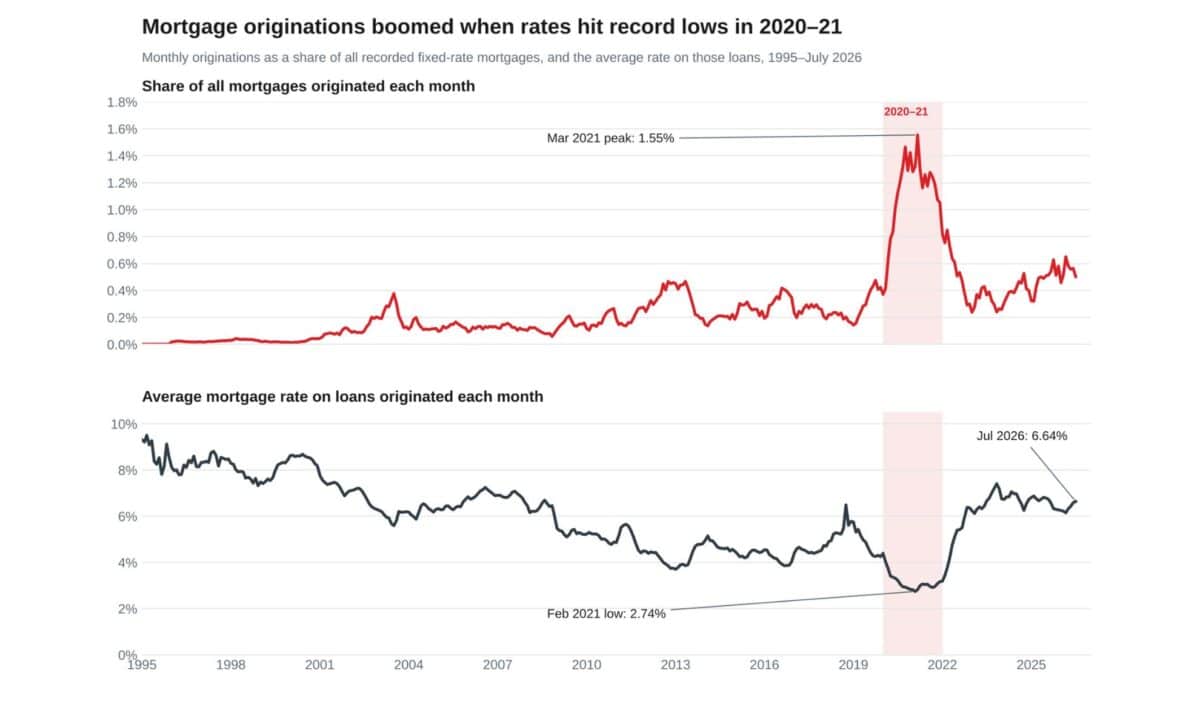
High Monthly Payments Continue To Discourage Homeowners From Moving
Despite the recent improvement in borrowing conditions, the financial gap between existing mortgages and new loans remains substantial.
According to Realtor.com’s housing study, the typical American mortgage holder currently pays $1,332 per month in principal and interest, with a median mortgage rate of 4.0%.
Buying a median-priced home at a 7.32% mortgage rate would increase that payment to $2,468, assuming a 14.3% down payment. That represents an 85.3% increase, or approximately $1,100 more each month.
The difference varies considerably between metropolitan areas. In Pittsburgh, replacing an existing mortgage with a loan on a median-priced home would increase monthly payments by 43.3%. In Portland, Maine, the increase would reach 167.0%.
High costs have also affected market activity. Pending home sales fell 10.5% year over year in October, while new listings declined 7.5%, according to figures reported by Newsweek.
Buyers who remain active nevertheless face less competition. Realtor.com senior economist Hannah Jones reported that 20.5% of active home listings received price reductions in October.
The affordability challenge extends beyond current borrowing rates. Realtor.com’s analysis found that mortgage rates would need to reach 6.0% for half of American households to afford a median-priced home. Even at that rate, the typical monthly payment would remain 61.7% higher than what existing mortgage holders currently pay.