
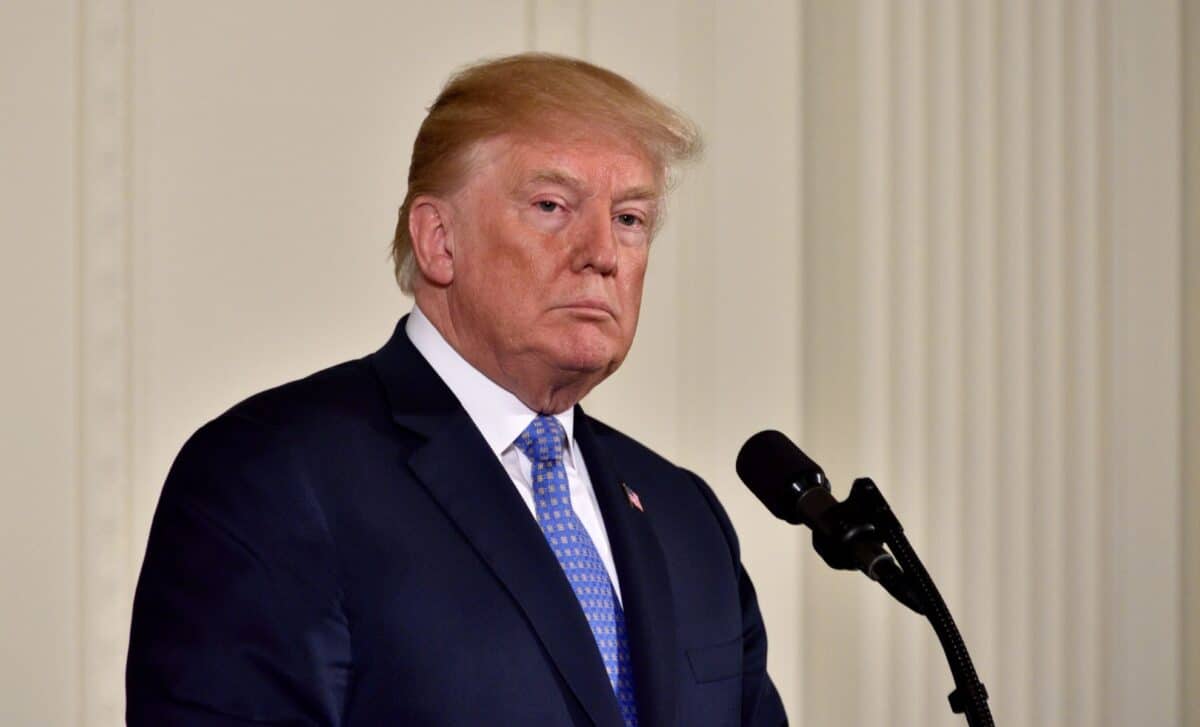
The U.S. administration under President Donald Trump has once again stirred the global economic scene, this time linking trade pressure to territorial ambitions. Tariffs on European nations were announced as leverage in an unlikely diplomatic push, the purchase of Greenland.
Trump’s Greenland Gambit
In an unexpected move, Donald Trump declared new tariffs on European countries until what he described as a “deal” is reached for the acquisition of Greenland. According to Yahoo Finance, the announcement triggered swift reactions in both European capitals and Copenhagen, where the Danish government reaffirmed that Greenland is “not for sale.”
Trump defended his reasoning with characteristic bravado, arguing that U.S. interests were at stake in the Arctic region.
“China and Russia want Greenland, and there is not a thing that Denmark can do about it. They currently have two dogsleds as protection, one added recently,” Trump wrote. “Only the United States of America, under PRESIDENT DONALD J. TRUMP, can play in this game, and very successfully, at that!”
This rhetoric underscores Trump’s view of Greenland not merely as a landmass but as a strategic foothold in the increasingly contested Arctic region. The U.S. has maintained a military presence in Greenland since World War II through the Thule Air Base, yet Trump’s comments reveal ambitions beyond defense, extending into resource control and geopolitical dominance.
Economic Ripples Across The Atlantic
The tariff announcement has unsettled European markets, already strained by ongoing trade tensions with the United States. European Union officials described the move as “unprovoked and destabilizing.” Financial analysts cited by Yahoo Finance noted that the new tariffs could affect industries from automotive manufacturing to agricultural exports, amplifying uncertainty in an already volatile post-pandemic recovery.
For Trump, tariffs have long served as a negotiation instrument, combining economic leverage with political messaging. During his presidency, he employed similar tactics against China and Mexico, arguing that trade restrictions were necessary to rebalance what he called “unfair practices.” By tying tariffs to the Greenland issue, Trump once again merged economic and geopolitical aims in a way that blurred traditional diplomatic lines.
Meanwhile, European governments have urged Washington to “separate trade from territorial politics.” Experts say such linkage sets a troubling precedent, suggesting that economic penalties could be used to advance territorial or strategic interests far beyond their intended scope.
The Arctic Stakes
Greenland’s importance extends beyond symbolism. The world’s largest island holds vast reserves of rare earth minerals, uranium, and hydrocarbons, resources that are increasingly valuable amid the global transition to renewable energy. The melting Arctic ice is also opening new shipping routes, making the region a hub for both trade and military positioning.
China has declared itself a “near-Arctic state” and invested in Greenlandic mining projects, while Russia has expanded its Arctic military infrastructure. Against this backdrop, Trump’s fixation on Greenland reflects a broader power competition over Arctic access. His remark about “two dogsleds as protection”, though clearly hyperbolic, highlights a belief that Denmark lacks the means to defend its Arctic territories from great-power interests.
Strategists point out that the U.S. views Greenland as essential for monitoring missile trajectories, tracking Russian submarines, and securing polar routes. Any American acquisition, however implausible, would transform Arctic dynamics and possibly strain NATO unity.